

Key Takeaways
- Human milk contains over 200 oligosaccharides (HMOs), but five types dominate research and supplementation: 2’-FL, 3-FL, LNT, LNnT, and 6’-SL.
- Each HMO type has distinct benefits. Fucosylated HMOs (2’-FL, 3-FL) support Bifidobacterium growth and immune defense. Neutral HMOs (LNT, LNnT) selectively feed beneficial bacteria. Sialylated HMOs (6’-SL) promote short-chain fatty acid production and gut barrier integrity.
- Complex HMO mixtures outperform individual HMOs. A 2023 clinical trial found that multi-HMO blends produced microbiome changes that single HMOs could not replicate (PMID: 37652940).
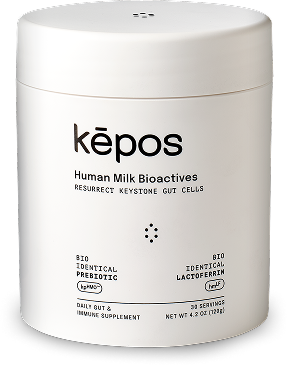
- kēpos delivers a multi-HMO blend plus effera™ human lactoferrin — a combination no single-HMO competitor can match.
What Are the Different Types of HMOs?
Human milk oligosaccharides are complex sugars found naturally in breast milk. They are the third most abundant solid component after lactose and fat, yet they are not digested by the infant — or the adult — for calories. Instead, HMOs travel intact to the large intestine, where they act as highly selective prebiotics and immune modulators.
Scientists have identified over 200 distinct HMO structures, but they fall into three major categories based on their chemical makeup: fucosylated (containing the sugar fucose), non-fucosylated neutral (built on an N-acetylglucosamine core), and sialylated (containing sialic acid). The five most studied — and most commonly supplemented — HMOs are 2’-FL, 3-FL, LNT, LNnT, and 6’-SL.
Understanding the differences between these HMO types matters because each one feeds different bacterial species and activates different biological pathways. That’s why a multi-HMO approach may deliver far broader benefits than any single HMO alone.
2’-FL (2’-Fucosyllactose): The Most Studied HMO
2’-Fucosyllactose is the most abundant HMO in the milk of “secretor” mothers, accounting for up to 30% of total HMO content. It is a trisaccharide — three sugar units — made from fucose bonded to lactose at the α-1,2 position.
2’-FL is the most clinically studied HMO for adults. In a landmark randomized, double-blind, placebo-controlled trial involving 100 healthy adults, Elison et al. demonstrated that supplementation with 2’-FL (alone or combined with LNnT) at doses up to 20 g/day was safe, well tolerated, and produced substantial increases in Bifidobacterium alongside significant reductions in Firmicutes and Proteobacteria (PMID: 27719686).
Beyond its prebiotic effects, 2’-FL has been shown to support immune function by acting as a decoy receptor — binding to pathogens and preventing them from attaching to intestinal cells. This anti-adhesion mechanism is one reason 2’-FL is associated with supporting defense against gastrointestinal infections.
Key benefits of 2’-FL:
- Selectively promotes Bifidobacterium growth in adults
- May support immune defense through pathogen decoy mechanisms
- Well tolerated at supplemental doses up to 20 g/day
- Associated with reduced abundance of potentially harmful Proteobacteria
3-FL (3-Fucosyllactose): The Emerging Immune Regulator
3-Fucosyllactose is structurally related to 2’-FL but differs in a crucial way: the fucose molecule attaches at the α-1,3 position rather than α-1,2. This seemingly small structural difference translates to distinct biological activity.
A comprehensive 2024 review in Archives of Microbiology summarized the growing body of evidence for 3-FL, finding that it promotes beneficial gut microbiota growth, exhibits antimicrobial properties, modulates immune function, offers antiviral protection, and may support brain maturation (PMID: 39143417).
One of the most interesting aspects of 3-FL is its anti-inflammatory potential. Preclinical research has shown that both 2’-FL and 3-FL may help alleviate intestinal inflammation by enhancing barrier function and advancing anti-inflammatory responses. 3-FL has also been recognized as Generally Recognized as Safe (GRAS) by the FDA, supporting its use in supplements and functional foods (PMID: 35438024).
Key benefits of 3-FL:
- Supports immune regulation and anti-inflammatory pathways
- Exhibits antimicrobial properties against harmful bacteria
- May contribute to antiviral defense mechanisms
- FDA GRAS status confirms safety for supplementation
LNT (Lacto-N-Tetraose): The Core Neutral HMO
Lacto-N-tetraose is one of the most abundant non-fucosylated neutral HMOs in breast milk. It is a tetrasaccharide — four sugar units — built on a Type I chain structure (Galβ1-3GlcNAc). LNT represents a structurally distinct class from the fucosylated HMOs, which means it interacts with different bacterial species and activates different biological pathways.
LNT is highly selectively metabolized by Bifidobacterium longum subsp. infantis, one of the most beneficial members of the gut microbiome. This selectivity is what makes LNT such an effective prebiotic — it feeds the good bacteria while starving the bad. Research has also shown that LNT may support immune health by inhibiting the adhesion of certain pathogens to intestinal cell walls, acting as a molecular decoy similar to the fucosylated HMOs but through a different structural mechanism.
Because LNT targets different bacterial populations than 2’-FL or 3-FL, including it in a multi-HMO blend means you’re covering a wider spectrum of beneficial microbiome modulation.
Key benefits of LNT:
- Highly selective prebiotic for B. longum subsp. infantis
- May support anti-pathogen adhesion in the gut
- One of the most abundant HMOs in breast milk
- Complements fucosylated HMOs by targeting different bacterial species
LNnT (Lacto-N-Neotetraose): The Clinically Validated Partner
Lacto-N-neotetraose is the Type II isomer of LNT, meaning it has the same four sugar units but with a different bond orientation (Galβ1-4GlcNAc instead of Galβ1-3GlcNAc). This subtle difference gives LNnT its own unique prebiotic profile.
LNnT is one of only two HMOs (alongside 2’-FL) with robust clinical trial data in adults. In the same landmark Elison et al. RCT, LNnT supplementation at 20 g/day produced significant increases in Actinobacteria and Bifidobacterium, with particularly notable growth in B. adolescentis and B. longum — species associated with healthy adult microbiomes (PMID: 27719686).
What makes LNnT especially valuable in combination with 2’-FL is that the two HMOs appear to stimulate different Bifidobacterium species. While 2’-FL preferentially supports species with extracellular fucosidase enzymes, LNnT feeds species that specialize in metabolizing neutral core structures. Together, they create a broader bifidogenic effect than either one alone.
Key benefits of LNnT:
- Clinically validated in a 100-person adult RCT
- Promotes B. adolescentis and B. longum specifically
- Complements 2’-FL by targeting different Bifidobacterium species
- Supports reduction of potentially harmful Proteobacteria
6’-SL (6’-Sialyllactose): The Barrier-Protecting Sialylated HMO
6’-Sialyllactose is the most prominent sialylated HMO — containing sialic acid (N-acetylneuraminic acid) rather than fucose. This structural distinction gives 6’-SL a fundamentally different mechanism of action from the fucosylated or neutral HMOs.
A 2024 study using the SHIME® model (Simulator of the Human Intestinal Microbial Ecosystem) found that 6’-SL significantly increased short-chain fatty acid (SCFA) production in adult gut microbiota — particularly propionate and acetate — while promoting the growth of Phascolarctobacterium and Lachnospiraceae, both SCFA-producing bacteria. Critically, the culture supernatant from 6’-SL treatment improved intestinal barrier function in Caco-2 cell monolayers (PMID: 38399656).
What makes 6’-SL unique is that it operates through a non-bifidogenic pathway. Unlike 2’-FL and LNnT, which primarily boost Bifidobacterium, 6’-SL promotes an entirely different set of beneficial bacteria. This means adding a sialylated HMO to a supplement formula creates a complementary layer of microbiome support that fucosylated HMOs alone cannot provide.
Key benefits of 6’-SL:
- Promotes SCFA production (propionate, butyrate, acetate)
- Supports gut barrier integrity and tight junction function
- Works through non-bifidogenic pathways, complementing other HMO types
- Sialic acid component may support brain health and cognitive function
Why a Multi-HMO Blend Outperforms Single HMOs
If each HMO type has distinct benefits, the logical question is: why not take them all?
The science strongly supports this approach. In a 2023 clinical trial, Jacobs et al. administered a complex HMO mixture derived from pooled donor breast milk to 32 healthy adults. The results were striking: the HMO blend produced dose-dependent Bifidobacterium expansion, altered microbial gene content, and increased circulating anti-inflammatory cytokines TGFβ and IL-10. Most importantly, these compositional shifts could not be replicated by individual HMOs or even a defined mixture of the 10 most abundant HMOs at their measured concentrations (PMID: 37652940).
This finding has profound implications for supplement selection. Products containing only a single HMO — such as standalone 2’-FL — are missing the synergistic interactions that occur when multiple HMO types work together. The research suggests that even low-abundance HMOs contribute to the overall microbiome-modulating effect.
How kēpos Delivers the Multi-HMO Advantage
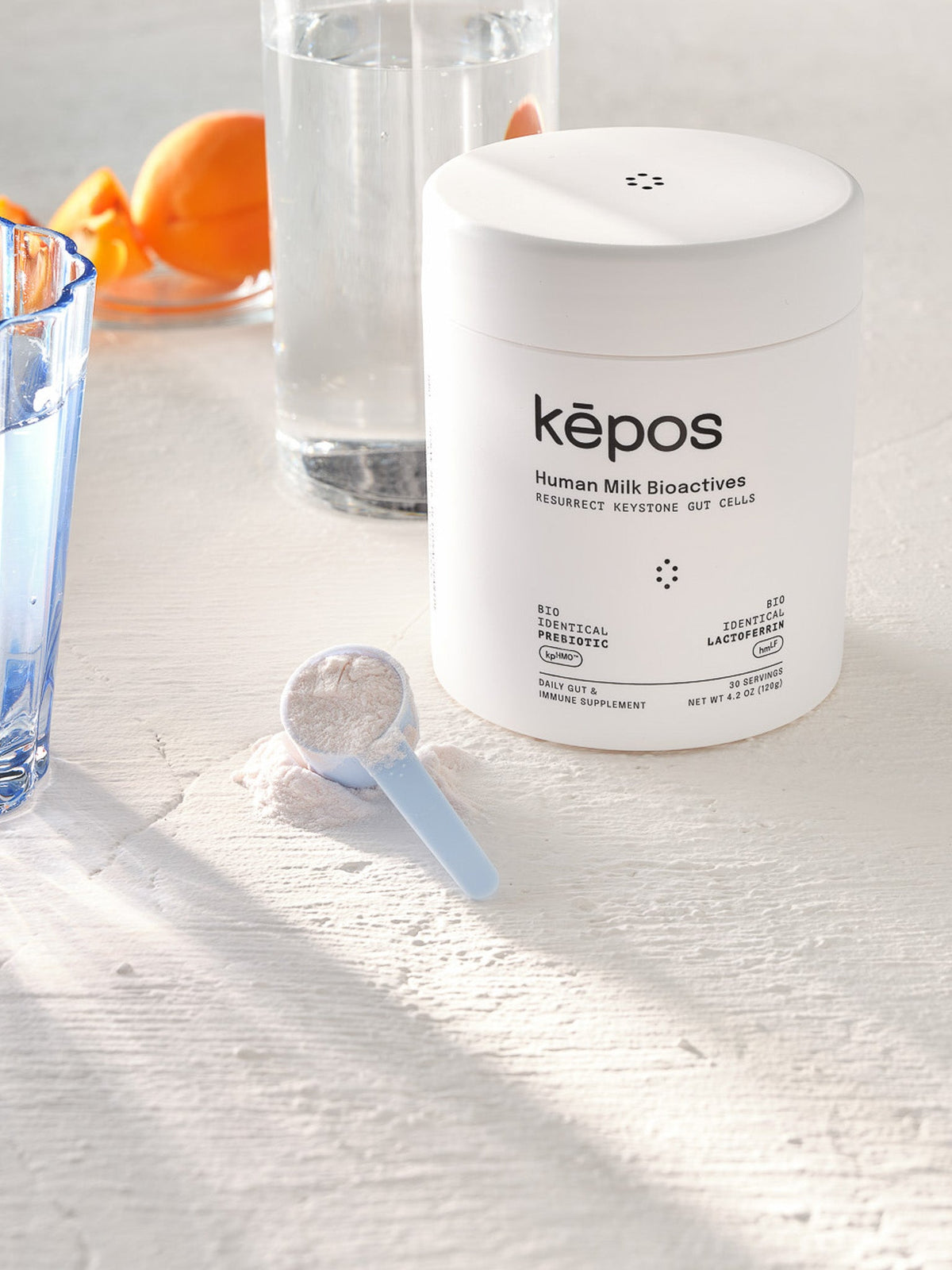
kēpos was formulated with this science in mind. Rather than relying on a single HMO type, kēpos provides a multi-HMO blend designed to deliver the broad-spectrum prebiotic, immune, and barrier-supporting benefits that the research shows require structural diversity.
But kēpos goes a step further. In addition to multiple HMO types, every serving includes effera™ recombinant human lactoferrin (rhLF) — identical in structure to the lactoferrin found in human breast milk. Lactoferrin supports iron absorption, promotes antimicrobial defense, and works synergistically with HMOs to create a gut environment that favors beneficial bacteria. This combination of multi-HMO plus human lactoferrin is a unique formulation you won’t find in single-HMO products.
If you’re looking for a gut health supplement backed by the latest HMO science, explore kēpos here.
Frequently Asked Questions
What are the 5 main types of HMOs?
The five most studied human milk oligosaccharides are 2’-FL (2’-fucosyllactose), 3-FL (3-fucosyllactose), LNT (lacto-N-tetraose), LNnT (lacto-N-neotetraose), and 6’-SL (6’-sialyllactose). They fall into three structural categories: fucosylated (2’-FL, 3-FL), neutral non-fucosylated (LNT, LNnT), and sialylated (6’-SL). Each type has distinct prebiotic and immune-modulating properties.
Is a multi-HMO supplement better than a single-HMO supplement?
Research suggests yes. A 2023 clinical trial (PMID: 37652940) found that complex HMO mixtures produced microbiome changes that individual HMOs or defined mixtures of the top 10 HMOs could not replicate. Multi-HMO blends activate different bacterial populations simultaneously, creating broader gut health support.
What is the difference between 2’-FL and LNnT?
2’-FL is a fucosylated trisaccharide that promotes Bifidobacterium species with fucosidase enzymes and supports pathogen decoy mechanisms. LNnT is a neutral tetrasaccharide that selectively feeds different Bifidobacterium species, particularly B. adolescentis and B. longum. Together, they provide a more comprehensive bifidogenic effect than either alone.
How is 6’-SL different from the other HMO types?
6’-SL (6’-sialyllactose) is a sialylated HMO, meaning it contains sialic acid instead of fucose. Unlike 2’-FL and LNnT, which primarily promote Bifidobacterium growth, 6’-SL works through non-bifidogenic pathways — boosting SCFA-producing bacteria like Phascolarctobacterium and Lachnospiraceae, and supporting gut barrier integrity.
Can adults benefit from HMO supplements?
Absolutely. Clinical trials have confirmed that HMO supplementation is safe and effective for adults. A randomized controlled trial of 100 adults showed that 2’-FL and LNnT significantly increased beneficial Bifidobacterium populations (PMID: 27719686). Adults experience many of the same prebiotic and immune-supporting benefits originally observed in infants.