

Key Takeaways
- HMOs work differently than probiotics — instead of introducing new bacteria, they selectively feed and amplify the beneficial bacteria already living in your gut.
- Probiotics face a colonization problem: a landmark 2018 Cell study found that many adults' guts actively resist probiotic colonization, limiting their effectiveness. (PMID: 30193112)
- HMOs produce lasting microbiome shifts: a double-blind RCT in 100 healthy adults showed HMO supplementation significantly increased Bifidobacterium — the key marker of a healthy gut. (PMID: 27719686)
- HMOs also repair the gut barrier, not just the microbiome — reducing intestinal permeability and supporting tight junction integrity. (PMID: 32466125)
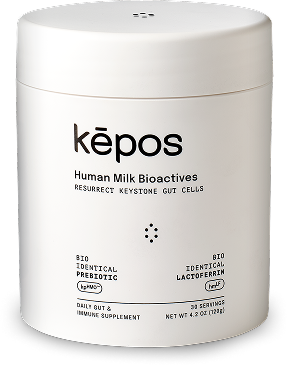
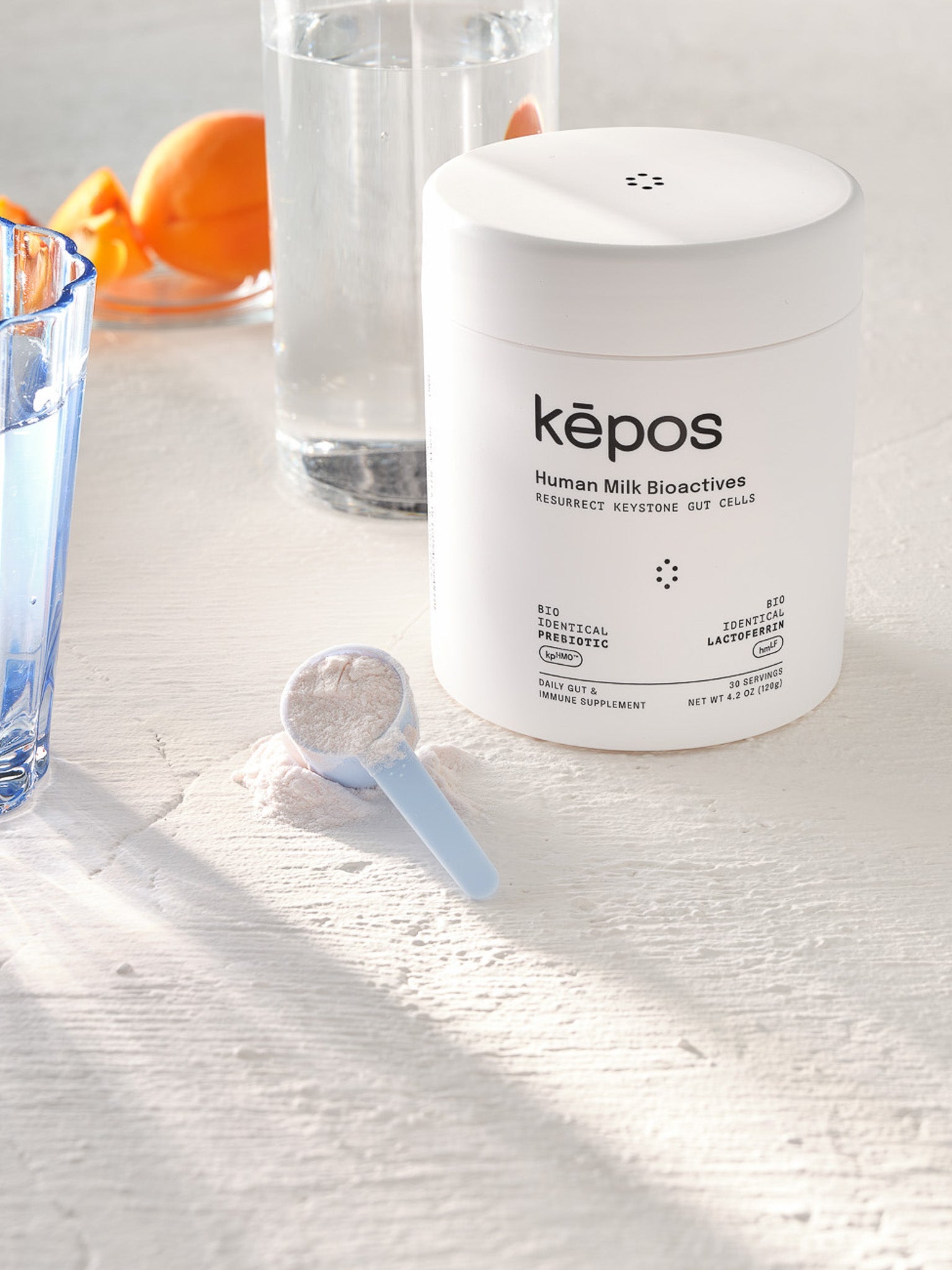
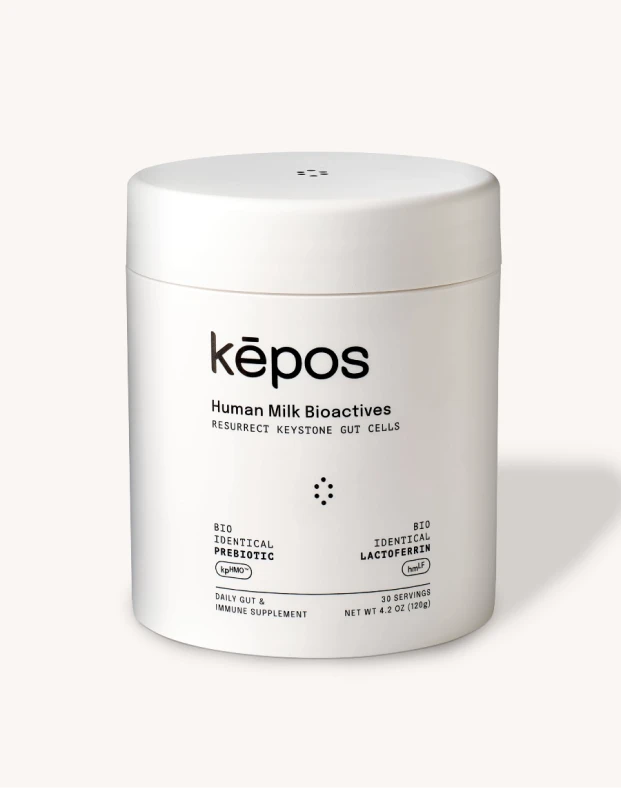
- kēpos combines HMOs with effera™ recombinant human lactoferrin — a synergy that goes beyond what either probiotics or single-target supplements can offer.
Probiotics have dominated the gut health conversation for the better part of two decades. They've earned their place on pharmacy shelves, in functional foods, and in wellness routines worldwide. And they do real work — under the right circumstances.
But a growing body of research is raising a question that supplement brands don't love to talk about: do probiotics actually colonize your gut? And if not, what does?
Enter human milk oligosaccharides — HMOs. These are the complex sugars found in breast milk that have been shown to reshape the gut microbiome in adults, strengthen the intestinal barrier, and support conditions like IBS. Researchers are now calling them one of the most significant developments in gut health science.
So how do HMOs compare to probiotics? Here's what the clinical evidence actually shows.
What Are Probiotics Doing for Your Gut?
Probiotics are live microorganisms — typically strains of Lactobacillus or Bifidobacterium — that, when consumed in adequate amounts, may confer a health benefit. The concept is straightforward: add good bacteria to your gut, improve your microbial balance.
And in certain contexts, probiotics genuinely help. They've shown benefits for antibiotic-associated diarrhea, some forms of IBS, and specific immune applications. The research is real.
The challenge is what happens after the bacteria arrive. Your gut is already home to trillions of microorganisms with established territorial claims. New arrivals — even beneficial ones — have to compete for space, nutrients, and adhesion sites.
Most of the time, they lose that competition.
The Colonization Problem Probiotics Don't Advertise
In 2018, a landmark study published in Cell gave the probiotics industry an uncomfortable moment. Researchers at the Weizmann Institute — led by Niv Zmora and colleagues — tracked probiotic colonization using colonoscopies and gut biopsies, not just stool samples.
What they found: many individuals showed strong mucosal resistance to standard probiotic strains. The bacteria appeared in stool — suggesting they passed through — but failed to meaningfully colonize the gut lining where it matters. Colonization success was highly personalized, unpredictable, and correlated with the individual's existing microbiome composition. (PMID: 30193112)
This explains something many probiotic users have noticed: the effects feel inconsistent. You take the capsule, maybe feel something for a while, and then it stops. That's because most probiotics are transient — they don't establish lasting communities. Once you stop supplementing, the benefit tends to fade.
This isn't a criticism of probiotics broadly. It's a structural limitation of the approach. When you're trying to change a complex ecosystem by importing foreign organisms, results will vary.
How HMOs Work — and Why It's Different
Human milk oligosaccharides take a fundamentally different approach. Rather than introducing new bacteria into your gut, HMOs act as precision prebiotics — feeding, amplifying, and structurally empowering the beneficial bacteria that already live there.
HMOs are not digested in the upper GI tract. They reach the colon intact, where they're selectively fermented by specific beneficial microbes — most importantly, Bifidobacterium species. This selectivity is key. HMOs don't provide blanket fermentation fuel to everything in your gut; they specifically nourish the bacteria associated with immune regulation, barrier integrity, and reduced inflammation.
A double-blind, randomized, placebo-controlled trial in 100 healthy adults demonstrated this directly. After HMO supplementation, participants showed substantial increases in Bifidobacterium relative abundance and a significant reduction in Firmicutes and Proteobacteria — a microbiome shift that researchers associate with better gut health outcomes. The changes were dose-dependent and occurred within weeks. (PMID: 27719686)
This is the bifidogenic effect — and it's where HMOs genuinely outperform standard prebiotics like inulin or FOS, which provide less targeted fermentation fuel.
HMOs Don't Just Change the Microbiome — They Protect the Gut Barrier
One of the most underappreciated HMO findings is their effect on intestinal permeability — what's sometimes called "leaky gut."
A 2020 study published in Nutrients examined HMO supplementation's effects on intestinal permeability and gut barrier gene expression. Researchers found that all HMO-supplemented female groups showed significant reductions in intestinal permeability compared to controls (p=0.02). The HMO groups also showed altered expression of tight junction proteins like ZO-1 and occludin — the molecular structures that keep gut contents from crossing into the bloodstream. (PMID: 32466125)
A separate investigation using the Simulator of the Human Intestinal Microbial Ecosystem (SHIME) — an advanced model of the adult gut — confirmed that HMOs both shifted microbiota composition toward beneficial species and supported gut barrier function simultaneously. (PMID: 32933181)
This dual mechanism — microbiome reshaping plus barrier protection — is something standard probiotics aren't consistently delivering. Most probiotics work through one pathway; HMOs work through multiple.
What About IBS? HMOs Have Clinical Evidence There Too
Irritable bowel syndrome affects roughly 10–15% of adults globally and is notoriously difficult to manage. Probiotics are commonly recommended — but results are mixed and strain-dependent.
HMOs are showing more consistent promise. A multicenter, open-label clinical trial found that HMO supplementation improved bowel habits and IBS severity scores while improving quality of life — without substantial side effects. (PMID: 33512807)
The mechanism makes sense. IBS is associated with microbiome dysbiosis, increased intestinal permeability, and immune dysregulation — all areas where HMOs show evidence of activity. Rather than treating a symptom, HMOs may be addressing the underlying microbial and structural environment.
HMOs vs. Probiotics: A Direct Comparison
Here's how the two approaches stack up across the most clinically relevant dimensions of gut health:
- Microbiome colonization: Probiotics introduce new strains — with inconsistent, often transient engraftment. HMOs amplify beneficial bacteria already present — creating durable, measurable shifts.
- Gut barrier support: Limited evidence for most probiotics. HMOs show direct effects on tight junction proteins and intestinal permeability in multiple studies.
- Selectivity: Most probiotics deliver 1–3 strains. HMOs nourish a broader spectrum of beneficial bacteria through precision prebiotic activity.
- IBS support: Some probiotic strains show moderate benefit. HMOs have multicenter clinical evidence for symptom and quality-of-life improvement.
- Structural similarity to human biology: Probiotics are not native to adult human biology. HMOs are derived from breast milk — the original human gut health formula.
That last point matters more than it might seem. HMOs aren't new compounds invented by a lab — they're the bioactives that human biology evolved to use for gut development and protection.
How kēpos Brings the HMO Advantage to Adults
Human milk oligosaccharides have shown remarkable benefits for adult gut health — and kēpos was built to deliver them in the most complete form possible.
At the core of kēpos is kpHMO™, a proprietary human milk bioactive ingredient designed and owned exclusively by kēpos, formulated to best match the full oligosaccharide composition found in real breast milk — covering all neutral, fucosylated, and sialylated bases. Unlike single-HMO supplements that deliver just one or two isolated oligosaccharides, kpHMO™ mirrors the structural diversity of breast milk's HMO spectrum. That diversity is what makes breast milk so uniquely effective — and it's what sets kpHMO™ apart from the field.
kēpos pairs kpHMO™ with effera™ recombinant human lactoferrin (rhLF) — the same iron-binding glycoprotein found in breast milk. Lactoferrin supports iron absorption, may modulate gut immune responses, and works synergistically alongside HMOs in ways no probiotic supplement is designed to deliver.
If you've tried probiotics and felt underwhelmed — that's not a failure of gut health commitment. It may simply be a structural limitation of what probiotics can do. The science on HMOs suggests there's a more fundamental lever to pull. Explore what kēpos may support for your gut.
Frequently Asked Questions
Are HMOs better than probiotics for gut health?
The research suggests HMOs may offer more consistent, durable gut microbiome changes than most probiotics. Unlike probiotics — which must colonize a competitive gut environment — HMOs work by selectively nourishing beneficial bacteria already present. Clinical trials in adults show significant Bifidobacterium increases and gut barrier improvements that most probiotic studies don't consistently replicate.
Can I take HMOs and probiotics together?
Yes — there's no contraindication to using both. Some researchers suggest HMOs may actually support probiotic engraftment by creating a more favorable microbial environment. That said, the emerging evidence positions HMOs as a more foundational gut health intervention, particularly for adults dealing with dysbiosis or barrier issues.
Do HMOs help with IBS?
A multicenter open-label clinical trial found that HMO supplementation improved IBS symptoms and quality of life without substantial side effects (PMID: 33512807). HMOs may help by addressing some of the underlying microbiome dysbiosis and intestinal permeability issues associated with IBS.
Why don't probiotics always work?
A landmark 2018 study in Cell found that many individuals show strong "colonization resistance" — meaning their existing gut microbiome actively blocks probiotic strains from taking hold. This is highly personalized and explains why probiotic results vary so widely between individuals (PMID: 30193112).
What makes kpHMO™ in kēpos different from other HMO supplements?
kpHMO™ is a proprietary ingredient designed and owned exclusively by kēpos, formulated to cover the full spectrum of oligosaccharide types found in breast milk — neutral, fucosylated, and sialylated. Most HMO supplements on the market use only one or two isolated HMO types. kēpos also pairs kpHMO™ with effera™ recombinant human lactoferrin — a combination unique in the gut health supplement space.
Author: Oliver Drazsky | References: PMID 27719686, PMID 32933181, PMID 32466125, PMID 30193112, PMID 33512807