

Key Takeaways
- Your gut microbiome does change meaningfully after 30 — and the decline accelerates with each decade.
- Bifidobacterium, the genus most associated with immune balance and gut integrity, drops substantially after age 50 (PMID 28593350).
- Beneficial species like Faecalibacterium and Lachnospiraceae also decline with age, reducing short-chain fatty acid production (PMID 33297486).
- Human milk oligosaccharides (HMOs) have shown the ability to selectively reverse this decline — a Stanford-led RCT found HMO supplementation increased Bifidobacterium by nearly 3× in just 3 weeks in older adults.
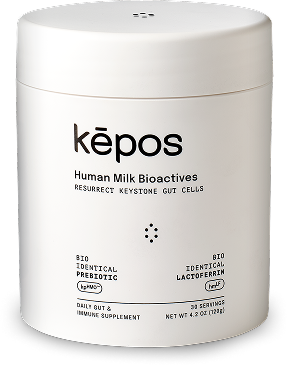
- kpHMO™, the proprietary HMO ingredient designed and owned exclusively by kēpos, is formulated to mirror the full oligosaccharide spectrum of real breast milk — offering the broadest possible support for a microbiome that's lost its edge.
You cleaned up your diet. You added probiotics. You started taking fiber. And yet something still feels off — bloating that won't quit, energy that dips after meals, digestion that just doesn't bounce back the way it used to.
Here's a possibility most people haven't considered: your gut microbiome may have quietly been changing since your early 30s. Not because of anything you did wrong — but because aging shifts the microbial terrain in ways that diet and standard supplements often don't address.
The good news? Researchers are now identifying exactly what changes, when, and — critically — what can reverse it.
What Actually Happens to Your Gut After 30
Your gut microbiome isn't static. It's a living ecosystem that evolves throughout your entire life — shaped by diet, environment, medications, stress, and biology. But after your early 30s, a consistent pattern begins to emerge across the scientific literature: the beneficial bacteria start to lose ground.
A 2020 systematic review published in Nutrients (PMID 33297486) analyzed 27 human studies on gut microbiome changes with aging. The findings were striking. Two of the most important microbial groups — Faecalibacterium and Lachnospiraceae — were consistently reduced in older adults. These bacteria are key producers of butyrate, the short-chain fatty acid that fuels colon cells, calms inflammation, and reinforces the gut lining. Fewer of them means less butyrate — and that has downstream effects throughout the body.
The review also found that microbial beta diversity (how different your microbiome is from other age groups) diverges significantly across life stages — even distinguishing younger-old from oldest-old adults. In other words, your gut at 60 looks measurably different from your gut at 40, which already looks different from your gut at 25.
The Bifidobacterium Problem
If there's one bacterial genus that defines a healthy gut, it's Bifidobacterium. These bacteria support immune regulation, produce B vitamins, and help maintain the protective mucus layer of the intestinal wall. Infants have extraordinarily high levels of Bifidobacterium. Adults have far less — and aging makes the gap wider.
A 2017 Japanese study (PMID 28593350) mapped age-related changes in Bifidobacterium species composition across human life stages. One of the clearest findings: Bifidobacterium breve — a species strongly associated with gut barrier integrity and immune modulation — showed a substantial decrease in subjects over 50. Other Bifidobacterium species showed similar age-related compositional shifts.
This matters for more than digestion. Bifidobacterium species are bifidogenic gatekeepers — they crowd out pathogenic bacteria, produce acetate that lowers gut pH, and signal to immune cells in the intestinal lining. When they decline, the whole ecosystem becomes less resilient.
Why Standard Approaches Often Fall Short
Most people's response to gut issues is predictable: probiotics, fiber, fermented foods. All of these have genuine value. But they also have a ceiling — especially when the underlying problem is a microbiome that has structurally shifted with age.
Probiotics introduce specific strains but don't fundamentally reshape the gut environment. Most probiotic bacteria are transient — they pass through without colonizing. Fiber feeds a broad range of bacteria, including ones you may not want to amplify. Neither approach is targeted at restoring the specific genera — Bifidobacterium chief among them — that aging depletes.
This is where the science on human milk oligosaccharides (HMOs) becomes genuinely exciting.
How HMOs Can Help Restore a Younger Microbiome
HMOs are complex sugar structures found abundantly in human breast milk. In infants, they serve a specific biological purpose: selectively feeding Bifidobacterium to build a healthy immune-educated gut. Researchers have spent years asking: does this bifidogenic power extend to adults? The answer, increasingly, appears to be yes.
In a landmark randomized controlled trial led by researchers at Stanford University and published in Cell Reports Medicine in 2025 (Carter et al.), 89 healthy older adults (average age 67.3 years) were randomized to receive either a placebo or the HMO 2'-fucosyllactose (2'-FL) at two different doses for six weeks.
The results were striking. In the high-dose group, Bifidobacterium relative abundance increased from a mean of 3.5% to 9.7% by week three — a nearly three-fold increase — compared to no meaningful change in the placebo group (P=0.0016). Beyond the microbiome itself, HMO supplementation was also associated with elevated HDL cholesterol and increased fibroblast growth factor 21 (FGF21), a hormone linked to metabolic health and longevity.
This isn't a theoretical mechanism. This is a placebo-controlled RCT in older adults showing that HMOs can meaningfully shift the microbiome back toward a younger, more Bifidobacterium-rich composition — in just weeks.
Where kēpos Comes In: kpHMO™ and the Full Spectrum Advantage
Human milk oligosaccharides are a diverse family — not a single compound. Real breast milk contains hundreds of distinct HMO structures, spanning neutral, fucosylated, and sialylated forms. Each plays a role in shaping the microbiome and supporting immune function.
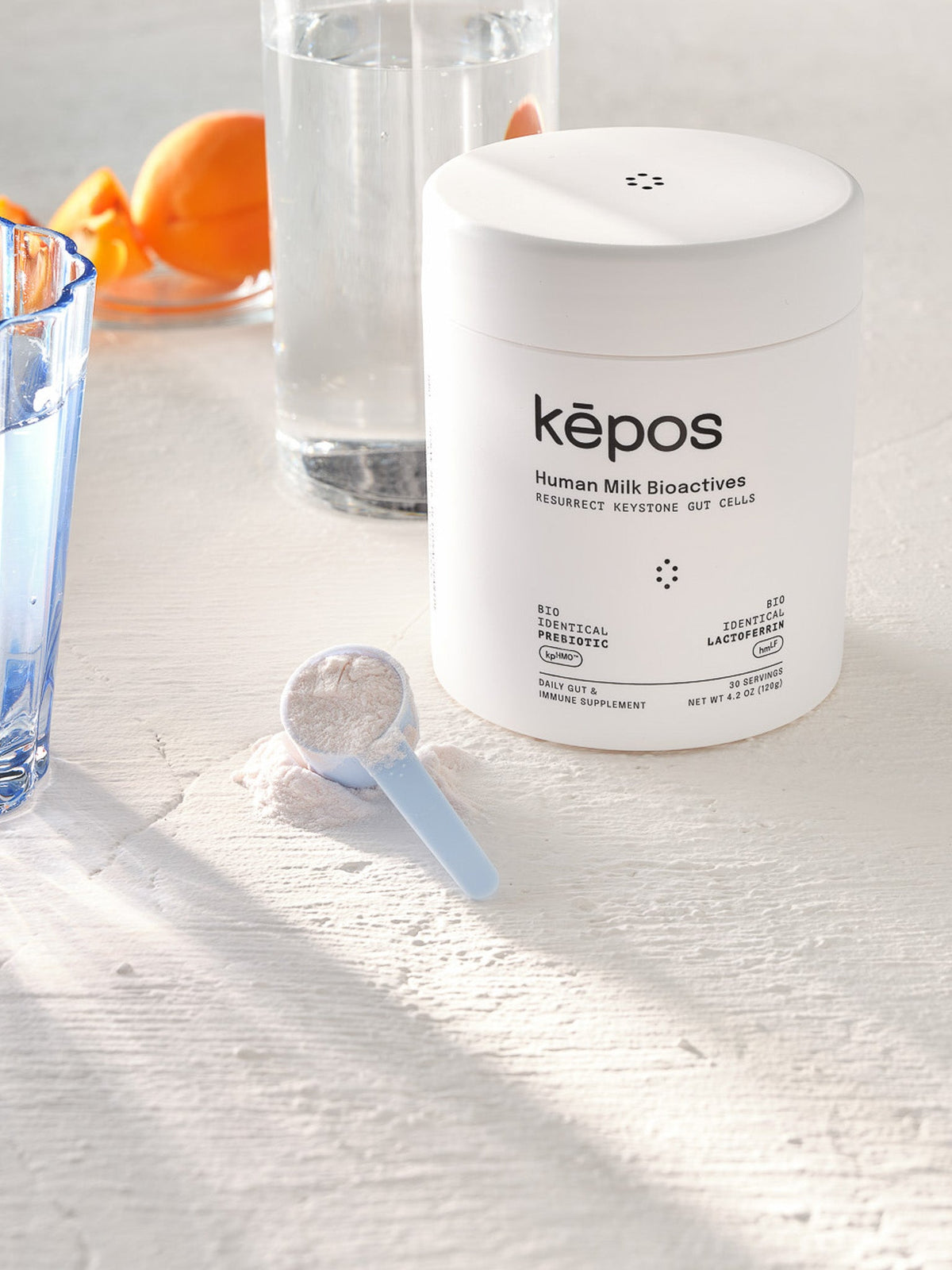
Most HMO supplements on the market offer one or two isolated HMO types. kpHMO™ is a proprietary human milk bioactive ingredient designed and owned exclusively by kēpos, formulated to best match the oligosaccharide composition found in real breast milk — covering all neutral, fucosylated, and sialylated bases. This full-spectrum approach means your gut gets the same diversity of prebiotic signals that naturally fuels a Bifidobacterium-rich microbiome.
kēpos pairs kpHMO™ with effera™ recombinant human lactoferrin (rhLF) — the only commercially available form of lactoferrin that's biologically identical to what's produced in the human body. Lactoferrin plays a complementary role: it supports iron absorption in the gut, modulates immune activity, and reinforces the gut barrier — functions that also decline with age and are closely tied to the same microbial imbalances HMOs help correct.
Together, they address the aging gut from two directions at once: restoring the microbial ecosystem with kpHMO™, and reinforcing the gut lining and immune environment with effera™.
If you're ready to support your gut with the science behind these two cutting-edge ingredients, explore kēpos here.
What You Can Do Starting Today
Microbiome aging isn't inevitable in its consequences. The research is clear that the right inputs — particularly bifidogenic HMOs — can meaningfully shift the microbial landscape even in older adults. Here's what the evidence supports:
- Add HMOs to your routine. Unlike probiotics, HMOs don't just pass through — they selectively feed and expand the bacteria your gut has been losing. The Stanford RCT showed meaningful Bifidobacterium restoration within three weeks.
- Support the full gut ecosystem. Pair HMOs with butyrate-boosting foods (cooked and cooled resistant starches, legumes) to amplify the short-chain fatty acid benefits that declining Lachnospiraceae can no longer provide on their own.
- Think about lactoferrin. Gut lining integrity and iron status both influence and are influenced by the microbiome. Lactoferrin addresses both simultaneously — making it a natural complement to HMO supplementation.
- Be consistent. Microbiome shifts take time to stabilize. The Stanford trial ran for six weeks — and saw meaningful change by week three. Sustained use matters.
Frequently Asked Questions
Does your gut microbiome really change in your 30s, or is that just for older adults?
The most dramatic shifts are documented in adults over 50 — particularly the loss of Bifidobacterium and short-chain fatty acid producers. But microbiome change is a continuous process, and research suggests compositional drift begins earlier. Addressing it proactively in your 30s and 40s is scientifically reasonable and may help maintain resilience heading into later decades.
What are HMOs and why are they relevant for adult gut health?
Human milk oligosaccharides (HMOs) are complex carbohydrates naturally found in breast milk. They selectively feed beneficial bacteria — especially Bifidobacterium — in a way that other prebiotics can't match. Clinical trials in adults have now demonstrated that HMO supplementation can meaningfully increase Bifidobacterium levels, making them highly relevant for anyone experiencing age-related gut changes. Learn more in our complete guide to HMOs.
Is kpHMO™ safe for adults?
Yes. HMOs are well-studied in both infant and adult populations, and kpHMO™ is designed as a dietary supplement ingredient. The Stanford RCT used HMOs in healthy older adults without significant adverse events. As always, consult your healthcare provider if you have specific health conditions.
How long does it take to see results from HMO supplementation?
The Stanford RCT observed significant Bifidobacterium increases within three weeks of daily HMO supplementation. Gut microbiome changes can happen relatively quickly once the right prebiotic inputs are consistently provided — though individual responses vary.
What makes kēpos different from a standard probiotic or prebiotic?
Probiotics introduce specific bacterial strains that are often transient and may not reshape the broader microbial environment. Standard prebiotics (like inulin or FOS) feed a wide range of bacteria indiscriminately. kpHMO™ is selectively bifidogenic — it specifically feeds and expands Bifidobacterium, the genus most consistently depleted with aging. Combined with effera™ human lactoferrin, kēpos supports both the microbial ecosystem and the gut lining that houses it. See what's inside kēpos.
This article is for informational purposes only and does not constitute medical advice. These statements have not been evaluated by the Food and Drug Administration. This product is not intended to diagnose, treat, cure, or prevent any disease.