

By Oliver Drazsky
Key Takeaways
- Gut symptoms often start before race day. In 96 recreational marathoners, 43% reported moderate GI symptoms in the week before the race, and food intake did not explain them (PMID 29937533).
- Hard training is a measurable gut stressor. A systematic review found intestinal injury, permeability, and endotoxaemia markers rise once exercise passes roughly 2 hours at 60% VO2max (PMID 28589631).
- Gut training helps symptoms, not the barrier markers. Carbohydrate practice cut gut discomfort by an average of 47% in two trials, yet markers of injury and permeability did not significantly change (PMID 37061651).
- Human milk oligosaccharides (HMOs) selectively feed Bifidobacterium in adults. Randomized trials show increases at doses up to 20 g per day with good tolerance. No HMO trial in athletes exists yet.
You practiced your carb intake. You tested every gel. You still hit mile 18 with cramping, nausea, or an urgent search for a bathroom.
The standard advice is to fix the fueling. The research suggests the problem often sits one layer deeper. The gut itself, and the microbial ecosystem that lives in it, is the variable most training plans never measure.
This article walks through what the studies show, where fueling fixes run out, and how a bifidogenic approach built on HMOs may fit into an athlete's gut strategy.
Why Do Runners Get GI Symptoms Even When Fueling Is Dialed In?
Because symptoms often appear in training too, and they track the individual rather than the menu.
A study of 96 recreational runners at the Liverpool and Dublin marathons found that 43% reported moderate GI symptoms in the 7 days before the race, and 27% reported them during it. Nutritional intake before and during the race showed no significant correlation with symptoms. Training symptoms and race symptoms were linked (r = 0.510) (PMID 29937533).
That is an observational study, and it does not prove fueling never matters. It does point to something important: runners who struggle on race day usually struggle in training. A person-level factor is at work.
What Does Hard Training Actually Do to the Gut Barrier?
It raises markers of intestinal injury and permeability, and the effect scales with duration, intensity, and heat.
A systematic review of exercise-induced gastrointestinal syndrome found that as exercise intensity and duration increase, so do indices of intestinal injury, permeability, and endotoxaemia. Gastric emptying slows, small intestinal transit slows, and malabsorption increases. About 2 hours at 60% VO2max appeared to be the threshold, regardless of fitness level (PMID 28589631).
The 2019 Boston Marathon gave a real-world snapshot. In 40 finishers, the gut injury marker I-FABP measured 3,367 pg/mL right after the race and fell to 1,657 pg/mL 24 hours later, about a 51% drop. Average symptom scores rose from 0.09 before the race to 0.84 after, then eased to 0.44 (PMID 37908334).
The good news in both papers: the changes are largely reversible. The open question is how well your gut ecosystem supports recovery between sessions.
Does Gut Training Fix the Problem?
It helps with symptoms, but it does not appear to change the underlying barrier markers.
A systematic review of eight gut-training trials found that two weeks of repeated carbohydrate feeding reduced gut discomfort by an average of 47% (two studies). Carbohydrate malabsorption fell by 45 to 54% in two studies. Symptom results across the wider group were mixed, and markers of intestinal injury and permeability showed no significant change (PMID 37061651).
Gut training is worth doing. Think of it as teaching your gut to tolerate fuel. It is not designed to rebuild the microbial community that digests, ferments, and signals on the gut's behalf.
What Does the Gut Microbiome Have to Do With Running?
The microbiome responds to exercise, and some of its members appear to feed back on performance.
Researchers at Harvard found that Veillonella rose in marathon runners after the race. These bacteria convert lactate into propionate. In mice, a Veillonella strain and propionate itself increased treadmill run time (PMID 31235964). The human data are observational and the performance data come from mice, so treat this as a mechanism, not a recommendation.
Probiotic trials in runners show a signal but a small one. In 24 recreational runners, four weeks of a multi-strain probiotic lowered GI symptom severity in the final third of a marathon. Speed dropped 7.9% in the probiotic group versus 14.2% on placebo, though finish times did not differ (PMID 30982100). In 10 runners exercising in the heat, a probiotic extended time to fatigue from 33:00 to 37:44, with lower endotoxin levels, while the permeability change was not statistically significant (PMID 24150782).
Both trials are small. They also share a design limit: adding bacteria assumes the ecosystem has the conditions and the food to keep them. We cover that gap in what HMOs do that probiotics cannot.
Can HMOs Support an Athlete's Gut Ecosystem?
HMOs have a strong evidence base for selectively raising Bifidobacterium in adults. Athlete-specific trials have not been run yet.
Here is what the adult trials show:
- 100 healthy adults: a two-week randomized trial found HMO supplementation was safe and well tolerated at doses up to 20 g per day and substantially increased Bifidobacterium (PMID 27719686).
- 60 adults with IBS: a randomized, placebo-controlled trial found a 10 g dose raised fecal bifidobacteria at week 4 without worsening symptoms (PMID 32536023).
- 317 adults with IBS: in an open-label trial with no placebo group, the share of bowel movements with abnormal stool consistency fell from 90.7% to 57.2% over 12 weeks (PMID 33512807).
- 89 healthy older adults: a six-week randomized trial of a single HMO raised Bifidobacterium. The primary immune endpoint was not met, and people who lacked Bifidobacterium at baseline were more likely to be non-responders (PMID 40738103).
The mechanistic layer comes from preclinical work, which we flag clearly. In a mouse colitis model, a sialylated HMO paired with B. infantis raised short-chain fatty acids and increased expression of the tight junction proteins ZO-1, occludin, and claudin-1 (PMID 40195063). In laboratory studies, butyrate-producing Roseburia and Eubacterium grew on distinct HMOs (PMID 32620774).
That last point matters. Different microbes use different HMO classes. A narrow input feeds a narrow slice of the community.
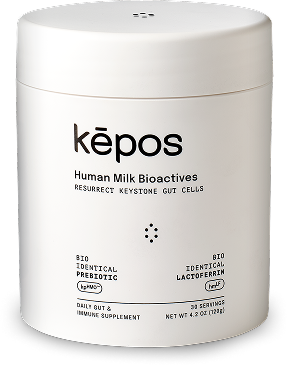
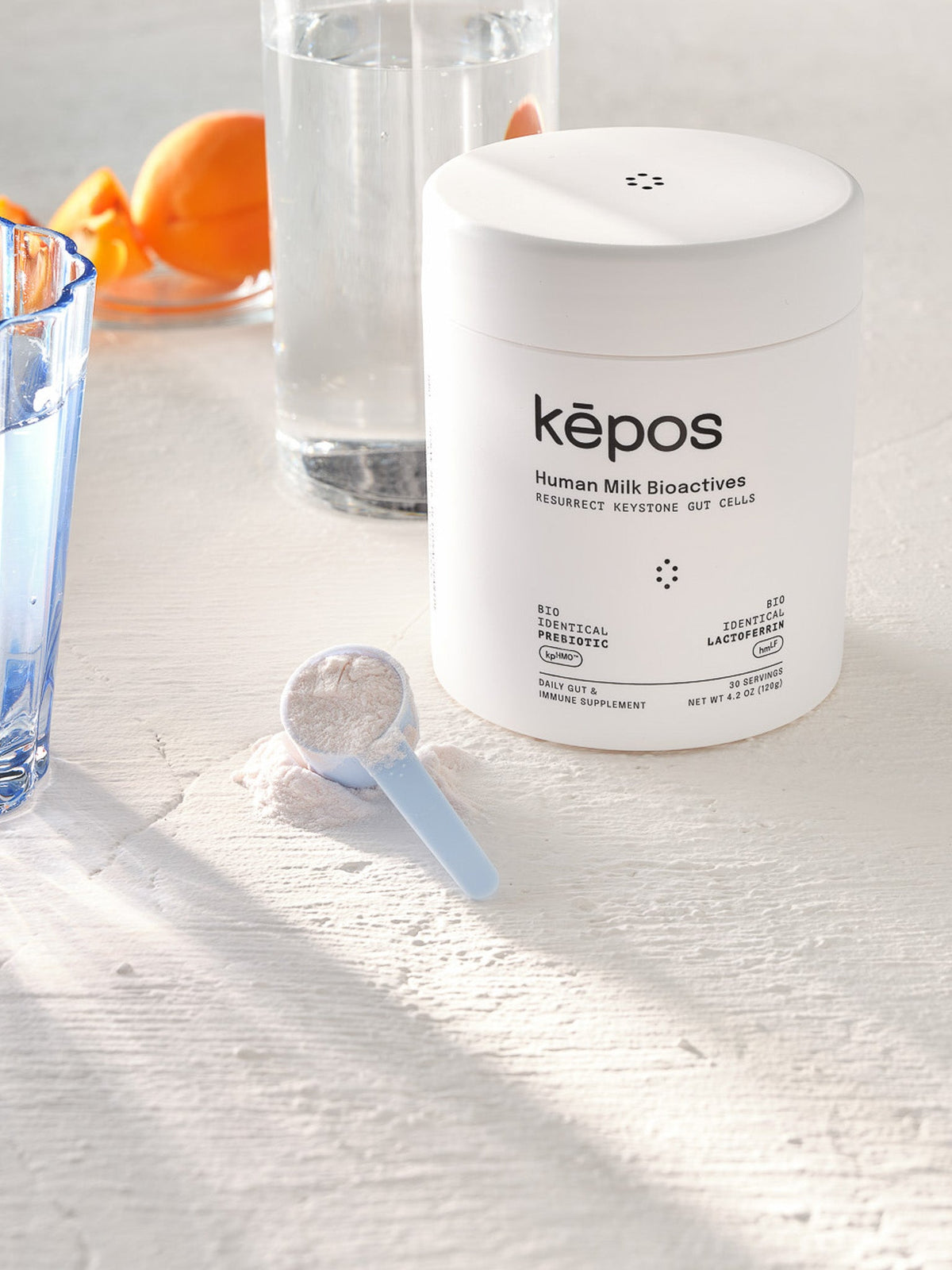
This is where kpHMO™ comes in. kpHMO™, a prebiotic originally discovered in human milk and recreated through Japanese fermentation, is a proprietary human milk bioactive ingredient designed and owned exclusively by kēpospos. It covers all neutral, fucosylated, and sialylated bases, formulated to best match the oligosaccharide composition found in real breast milk.
How Does kēpospos Fit Into a Training Stack?
kēpospos pairs kpHMO™ with effera™ recombinant human lactoferrin, a human milk bioactive that supports the gut's natural defenses. The goal is to support the ecosystem that sits underneath your fueling plan, not to replace it.
A practical way to think about it:
- Keep gut training. It remains the best-supported way to improve fuel tolerance.
- Add an ecosystem layer. HMOs target the Bifidobacterium foundation that gut training does not address.
- Track your own response. The Bifidobacterium trials suggest responses vary, and baseline levels matter.
If you want to see how this works in practice, explore kēpospos human milk bioactives or read how neutral HMOs relate to gut barrier integrity. For more on the science, visit the kēpospos blog hub or the kēpospos homepage.
If you have persistent GI symptoms, blood in your stool, or unexplained weight loss, talk with a clinician. Supplements are not a substitute for medical evaluation.
Frequently Asked Questions
Why does my stomach hurt when I run?
Prolonged, intense exercise slows gastric emptying and small intestinal transit and raises markers of intestinal injury and permeability. Heat and running mode make this worse (PMID 28589631). Individual factors, including your gut ecosystem, influence how strongly you feel it.
Is runner's gut caused by what I eat?
Not only. In 96 recreational marathoners, nutritional intake did not significantly correlate with GI symptoms, and training symptoms predicted race symptoms (PMID 29937533). Fueling still matters, and gut training can reduce discomfort.
Do probiotics help with exercise GI symptoms?
Small randomized trials show lower symptom severity in marathon runners (PMID 30982100). The samples are small, and benefits for finish time were not shown. Probiotics add strains. HMOs feed the Bifidobacterium already present.
Have HMOs been studied in athletes?
Not to our knowledge. Adult trials in healthy people, older adults, and people with IBS show increases in Bifidobacterium with good tolerance. Athlete-specific research is a clear next step.
How long do HMOs take to shift Bifidobacterium?
In the trials above, increases were reported after two weeks (PMID 27719686), at week 4 (PMID 32536023), and after six weeks (PMID 40738103). Responses vary by person and baseline microbiome.