





Key Takeaways
- Adult HMO research has demonstrated increases in bifidobacteria, with responses varying between people.
- A gut supplement is not an established prerequisite for NMN, collagen, or a longevity stack to work.
- Match each ingredient to a specific outcome. A change in NAD levels or gut bacteria does not demonstrate longer life.
- Persistent digestive symptoms deserve their own assessment, rather than another supplement added automatically.
You can take your supplements consistently and still be unsure what they are doing. For women over 50, a longevity stack often combines ingredients aimed at different goals: NMN for cellular metabolism, collagen for skin or bone, and something for digestion. Adding another bottle can feel easier than deciding whether the existing ones deserve their place.
Gut health belongs in that decision, but it is not a universal explanation for a disappointing stack. There is no established requirement to take a gut supplement before NMN or collagen can have an effect. The useful question is narrower: does your digestive health, your target outcome, or the evidence justify adding one?
Yesterday's guide explored gut supplements and healthy aging in women over 50. Here, the focus is auditing a stack you already take, rather than assuming it needs a missing ingredient.
1. What does “working” mean for your longevity stack?
Choose an outcome before choosing another supplement. Better bowel regularity, a bone-density measurement, and a blood biomarker are different goals. A supplement can influence one without changing the others.
A systematic review of 12 NMN studies involving 513 adults found that supplementation increased blood NAD levels. Most clinically relevant glucose and lipid outcomes, however, did not differ significantly from controls. The authors identified risk-of-bias concerns across the included studies. That makes “my NAD increased” a different claim from “my metabolic health improved.” [1]
For each item, write down the intended benefit, the evidence supporting it, and how you will assess it. If the only answer is “longevity,” the goal needs more definition. None of the trials discussed here demonstrated that a supplement stack extends human lifespan.
2. Does the NMN or collagen study actually fit you?
Age and sex alone are not enough. The study population, ingredient, dose, and endpoint determine how much a finding can tell you.
In a 10-week placebo-controlled trial, NMN improved muscle insulin sensitivity in postmenopausal women with prediabetes who were overweight or obese. This is a specific metabolic result in a selected population, not proof of general rejuvenation or the same benefit in metabolically healthy women. It also does not show that adding an HMO would amplify the effect. [2]
A separate trial enrolled 131 postmenopausal women with reduced bone mineral density. Taking 5 grams of specific collagen peptides daily for 12 months improved spine and femoral-neck measurements relative to placebo; 102 women completed the study. The results concern those peptides and bone measurements, not every collagen product or fewer fractures. [3]
These findings give ingredients defined jobs. Neither establishes a need for a supplementary “gut layer” to unlock its effects. Bone concerns still warrant an appropriate clinical assessment, rather than relying on a supplement label.
3. Is your gut uncomfortable, or are you assuming poor absorption?
Bloating does not, by itself, establish malabsorption or a microbiome deficiency. Treat symptoms as information, not as a diagnosis that explains every disappointing supplement result.
Review when symptoms began and whether they followed a new product, a dose increase, or several additions at once. A clinician or pharmacist can help assess the complete list, including medications. Change one nonessential item at a time when appropriate, rather than building a larger stack around an unidentified trigger.
The American Gastroenterological Association's bloating guidance recommends considering specific causes, including carbohydrate intolerance, celiac disease, and constipation-related evacuation problems. Testing should follow the clinical picture. It does not recommend probiotics as a treatment for bloating and distention, and reserves imaging or endoscopy for situations such as alarm features or recent worsening. [4]
Persistent symptoms, unintentional weight loss, blood in stool, or repeated vomiting call for medical assessment. Those are not signals to keep experimenting with gut supplements. Symptoms and suspected absorption problems need evaluation before a product is asked to solve them.
4. What would an HMO add, and what remains unproven?
HMOs offer a researched way to influence resident gut bacteria. That is a meaningful biological action, but it does not establish an upgrade to your entire longevity stack.
A six-week randomized trial in 89 healthy older adults tested an individual HMO. Supplementation increased bifidobacteria, while the primary cytokine-response endpoint was not met. Participants lacking bifidobacteria at baseline were more likely to be microbiome nonresponders. The study supports microbial activity and variable responses, not a universal benefit or lifespan extension. [5]
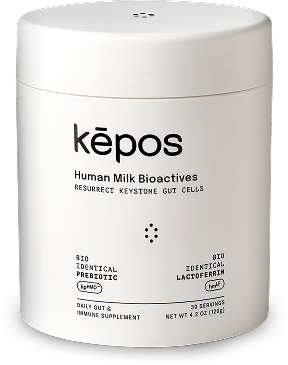
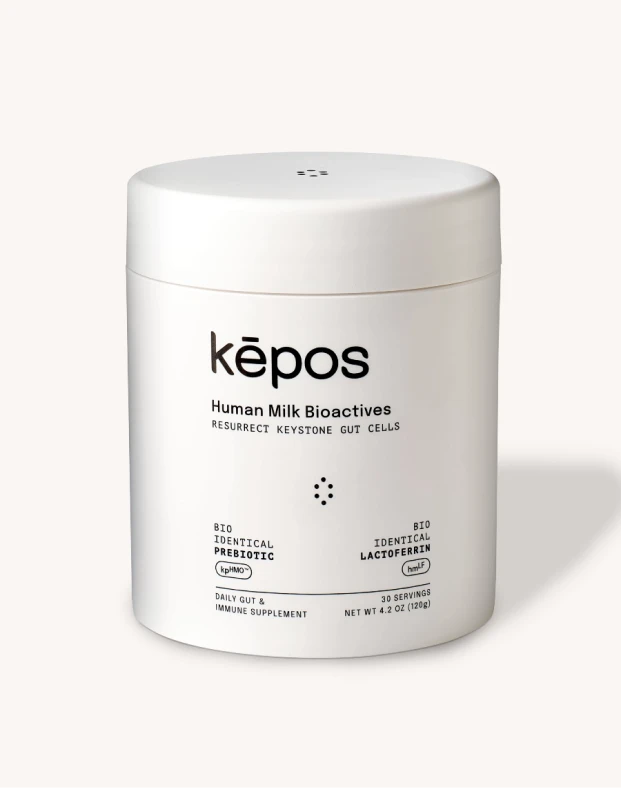
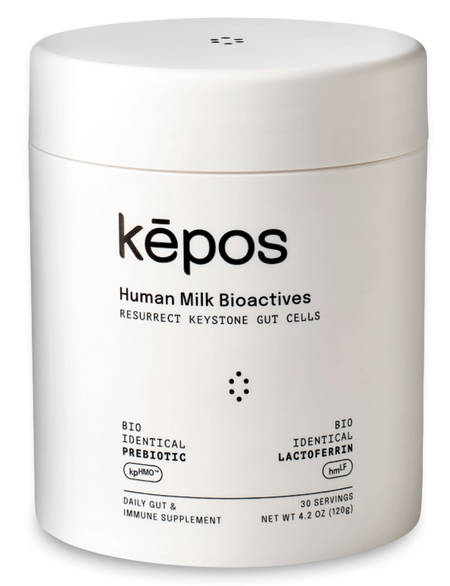
In that HMO context, kpHMO™, a prebiotic originally discovered in human milk and recreated through Japanese fermentation technology, is a proprietary ingredient designed and owned exclusively by kēpos. Its composition covers neutral, fucosylated, and sialylated HMO families. That design description does not mean the individual-HMO trial tested kpHMO™.
kēpos also includes effera™, recombinant human lactoferrin. A 28-day randomized trial comparing two effera™ doses with bovine lactoferrin examined exploratory microbiome and fecal-metabolite outcomes in 66 healthy adults. There was no placebo group; overall microbial diversity remained stable, and the authors described the findings as hypothesis-generating. This ingredient research does not prove improved NMN absorption, collagen efficacy, menopause symptoms, or longevity from finished kēpos. [6]
5. Can you make the next decision without adding everything?
A useful stack is one you can evaluate. Start with a specific purpose, check whether the evidence matches you, and decide what would count as a worthwhile result.
- Keep an accurate list of doses, start dates, symptoms, and medications.
- Choose a follow-up appropriate to the goal, rather than interpreting every sensation as proof.
- Avoid starting several optional products simultaneously if you want to identify benefits or intolerance.
If you are considering HMO-based microbiome support, review the ingredients and directions for kēpos with those limits in mind. The cited studies do not establish the benefits of combining it with NMN or collagen. Browse the kēpos research library for ingredient-specific evidence. Your next addition should answer a real question, not make the stack harder to understand.
Sources
Six verified references: NMN evidence synthesis; NMN trial in postmenopausal women; collagen and bone-density trial; AGA bloating guidance; older-adult HMO trial; lactoferrin microbiome trial.
Frequently Asked Questions
Do women over 50 need a gut supplement with NMN?
No such requirement has been established. NMN's benefits depend on the outcome and population studied, not a proven need to pair it with an HMO.
Does bloating mean my collagen is not being absorbed?
No. Bloating alone does not establish poor absorption. Review symptom timing and seek assessment for persistent symptoms or alarm features.
Can HMOs make a longevity stack work better?
Adult trials show microbiome changes, but the cited research does not establish improved outcomes from combining HMOs with NMN or collagen.
Is increased bifidobacteria proof of longer life?
No. A bacterial change is a biological finding. It is not a demonstrated improvement in lifespan or a guarantee of better symptoms.
What is kpHMO™?
kpHMO™, a prebiotic originally discovered in human milk and recreated through Japanese fermentation technology, is a proprietary ingredient designed and owned exclusively by kēpos. It covers neutral, fucosylated, and sialylated HMO families.