

By Oliver Drazsky
Key Takeaways
- Human milk oligosaccharides (HMOs) feed Bifidobacterium, and in a randomized trial of 100 healthy adults, daily doses up to 20 g were well tolerated and increased Bifidobacterium abundance.
- A systematic review of 24 case-control studies found lower Bifidobacterium and Faecalibacterium and higher Enterobacteriaceae in people with IBS, an association that points to the ecosystem, not just the symptom.
- After a 4-day antibiotic course, 9 species present in every volunteer were still undetectable in most of them 180 days later.
- Adding bacteria is not the same as rebuilding a community. Invasive human sampling showed person-specific, often transient probiotic colonization.
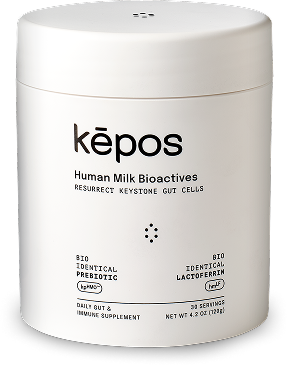
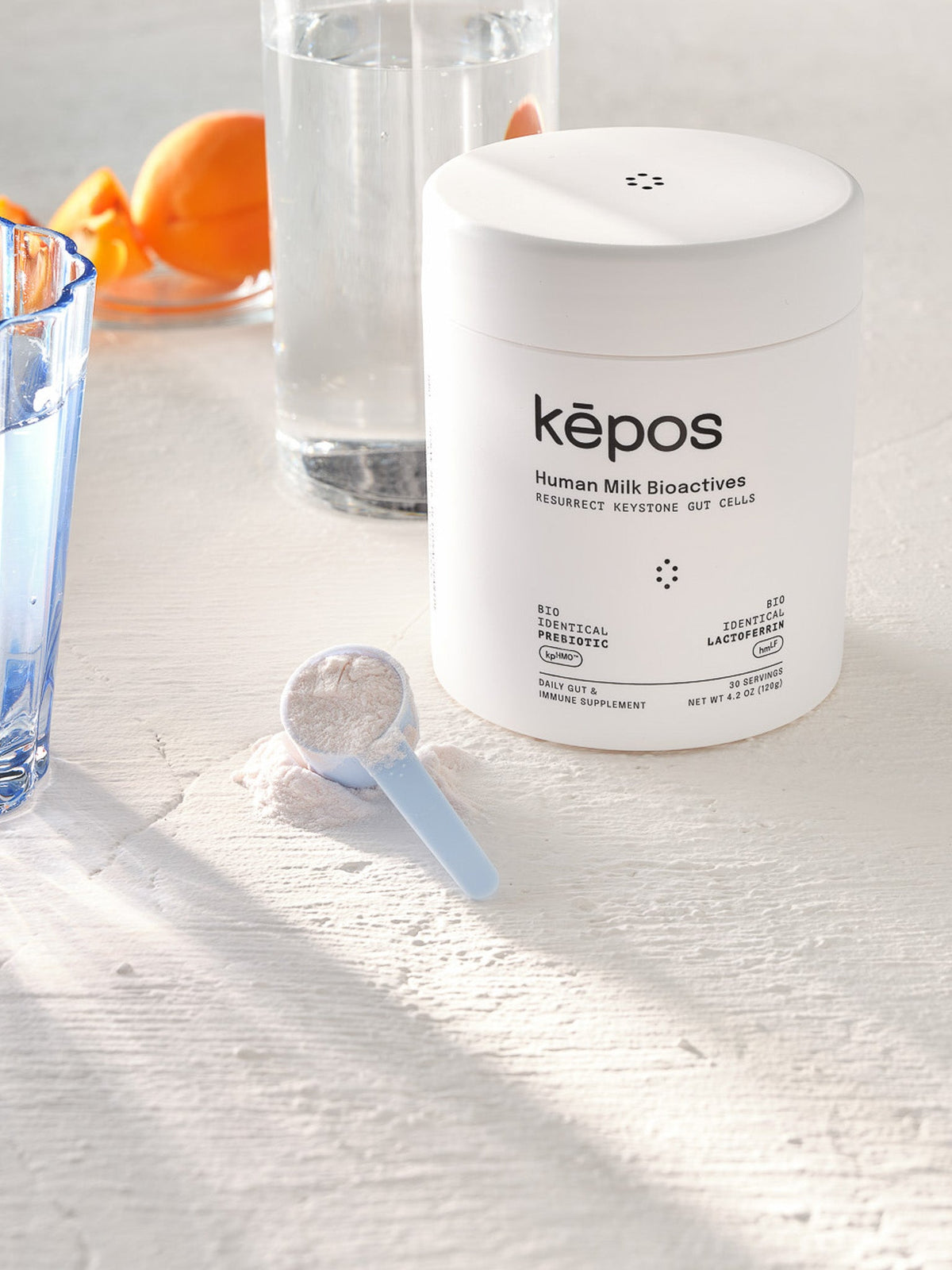
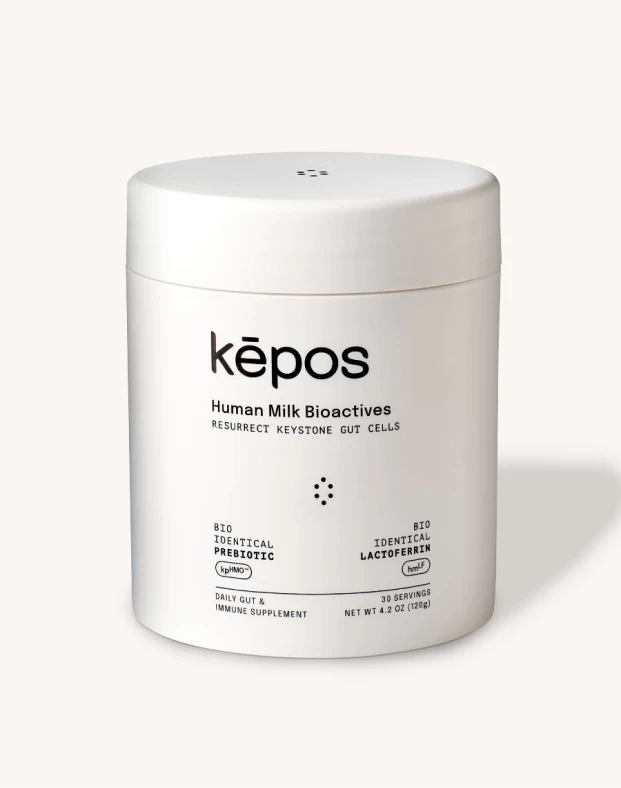
- kēpos pairs kpHMO™, a prebiotic originally discovered in human milk and recreated through Japanese fermentation, with effera™ recombinant human lactoferrin to support the ecosystem you already have.
If you have spent years rotating through fixes, you are not failing. Most gut advice was built to quiet a symptom, and quieting a symptom is a reasonable thing to want. The problem is that symptom-first thinking rarely asks what the community inside your gut has lost.
This guide lays out a different framework, built on what the research actually shows. It moves from patching to restoring, and it is honest about what each study can and cannot tell us.
What is the difference between patching the gut and restoring it?
Patching targets the symptom. Restoring targets the ecosystem that produces it. A patch is anything that works on the outcome: something to calm the bloat, something to speed things up, something to slow things down.
Restoring asks a different question. Which members of the microbial community are depleted, what do they eat, and what has been missing from the environment that feeds them?
The two approaches are not enemies. But only one of them addresses why the same symptoms keep returning when the patch wears off.
Do chronic gut issues really track with a changed ecosystem?
In IBS, yes, consistently, though the research shows association rather than proven cause. A 2019 systematic review in Gastroenterology screened 2,631 citations and pooled 24 case-control studies. Compared with healthy controls, people with IBS had more Enterobacteriaceae and fewer Bifidobacterium and Faecalibacterium.
The authors were careful: they could not say whether these microbes are a product or a cause of IBS. That caution matters. It also means the ecosystem is a legitimate place to look, because the same community shifts keep appearing across studies.
Why doesn't the gut ecosystem just rebuild itself?
Some members, once lost, may not come back on their own. In a study of 12 healthy men in Nature Microbiology, researchers followed gut bacteria for 6 months after a 4-day antibiotic cocktail. Bifidobacterium species and butyrate producers were depleted early on.
The community recovered to near-baseline composition within about 1.5 months. Yet 9 common species, present in all 12 men before treatment, remained undetectable in most of them after 180 days.
Preclinical work points the same direction. In a Nature study in mice carrying a human microbiota, a low-fiber diet caused diversity loss across generations that was not recoverable by reintroducing fiber alone. Restoring the community required the missing taxa and the dietary substrate together. That is a mouse model, so treat it as mechanistic rationale, not proof in humans.
The takeaway is simple. A functioning ecosystem needs both the organisms and the food that sustains them.
Why can't more probiotics close the gap?
Because delivering organisms is only half of restoration, and the gut mucosa does not accept every newcomer. Two companion Cell papers from 2018 examined this directly, using invasive sampling of the gut lining in human volunteers alongside mouse work.
- The first study found person-, region-, and strain-specific colonization patterns, and an overall transient, individualized impact on the mucosal community.
- The second study found that after antibiotics, probiotics were associated with delayed and persistently incomplete reconstitution of the native microbiome compared with spontaneous recovery.
This does not mean probiotics have no role. It means they were never designed to be the foundation. If the environment that supports native Bifidobacterium is missing, adding more bacteria is a patch. For a closer look, see our piece on why probiotics stop working.
What does a restoration framework actually look like?
It has three moves: feed what is already there, cover the full spectrum, and stay consistent.
1. Feed the native community with the substrate it evolved around
Human milk oligosaccharides are the prebiotic that nature built to feed Bifidobacterium. In a randomized, double-blind, placebo-controlled trial of 100 healthy adults, one or two HMOs taken for 2 weeks at various doses up to 20 g daily were well tolerated. 16S sequencing showed substantial increases in Bifidobacterium and Actinobacteria, with reductions in Firmicutes and Proteobacteria.
The mechanism matters too. In a Nature mouse model, acetate produced by protective bifidobacteria supported epithelial defense against a lethal infection. That is preclinical, but it explains why Bifidobacterium abundance is a meaningful target. You can read more in what HMOs actually feed.
2. Cover the full spectrum, not a single molecule
The clinical trials above tested no more than two HMOs. Human milk contains a far richer oligosaccharide spectrum, spanning neutral, fucosylated, and sialylated structures. Narrow dosing captures a fraction of what the gut ecosystem evolved to receive.
kpHMO™, a prebiotic originally discovered in human milk and recreated through Japanese fermentation, is a proprietary ingredient designed and owned exclusively by kēpos. It is formulated to best match the oligosaccharide composition found in real breast milk, covering all neutral, fucosylated, and sialylated bases.
3. Stay consistent, because the signal fades
Here is the honest nuance. In a randomized trial of 60 adults with IBS, a 10 g daily dose increased fecal Bifidobacterium at week 4, but the increase was not seen at week 8, four weeks after supplementation stopped. No symptom deterioration occurred in any group.
A follow-up analysis of the same trial showed that both fecal and mucosal Bifidobacterium increased, including Bifidobacterium longum, and that metabolite profiles shifted alongside. The microbial change tracked with intake. That is what you would expect from a food source, not a one-time fix, and it argues for treating restoration as a routine rather than a rescue.
How can kēpos support gut ecosystem restoration?
kēpos is built around the restoration idea: feed the ecosystem with what human milk science identified, then keep feeding it. What nature built into human milk, kpHMO™ brings to life through Japanese fermentation, giving your native Bifidobacterium the substrate it was designed around.
It is paired with effera™ recombinant human lactoferrin, a human milk bioactive that rounds out the product. Together they support a healthy gut environment rather than masking what it is telling you.
Ready to move from patching to restoring? Explore kēpos human milk bioactives, or browse more research on the kēpos science hub.
This article is for educational purposes and is not medical advice. If you have persistent or severe digestive symptoms, speak with a qualified clinician.
Frequently Asked Questions
Why do my gut problems keep coming back?
Symptom-focused approaches act on the outcome, not the community producing it. Research on IBS shows consistent ecosystem differences, including lower Bifidobacterium, and antibiotic research shows some species may stay undetectable for months. Supporting the ecosystem may help address the underlying pattern.
What are human milk oligosaccharides and how do they support the gut?
HMOs are complex prebiotic carbohydrates first identified in human milk. They selectively feed Bifidobacterium. In a 100-person adult trial, HMO supplementation was well tolerated and increased Bifidobacterium abundance.
Are probiotics useless for chronic gut issues?
No. But research using invasive human sampling found colonization is individualized and often transient, and that after antibiotics probiotics were associated with slower native recovery. Probiotics add organisms. HMOs feed the ones you already host.
How long does it take to see a change in gut bacteria with HMOs?
In the adult trials cited here, Bifidobacterium shifts were measured after 2 to 4 weeks of daily supplementation. In the IBS trial the increase was not present four weeks after stopping, which supports consistent daily use.
Is kpHMO™ derived from human milk?
No. kpHMO™ is a prebiotic originally discovered in human milk and recreated through Japanese fermentation. It is inspired by human milk, not sourced from it.