

Key Takeaways
- In a 317-person multicenter clinical trial, HMO supplementation produced a 69% improvement in IBS symptom scores in adults (PMID: 33512807).
- HMOs enrich Bifidobacterium in the adult gut and significantly reduce intestinal permeability — the two hallmarks of a restored gut microbiome.
- Sialylated HMOs measurably reduce IL-6, IL-8, TNF-α, and NF-κB signaling in gut tissue — documenting real anti-inflammatory action.
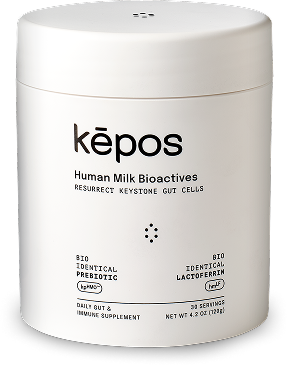
- kpHMO™, the proprietary HMO ingredient designed and owned exclusively by kēpos, covers all three HMO classes — meaning the full evidence base for every mechanism applies.
- effera™ recombinant human lactoferrin in kēpos amplifies HMO prebiotic effects, producing outcomes neither ingredient achieves independently.
Does kpHMO™ work? The short answer is yes — and the evidence is specific, measurable, and mechanistically sound. In a 317-person multicenter clinical trial, adults supplementing with human milk oligosaccharides reported a 69% improvement in IBS symptom severity compared to baseline, alongside normalized bowel habits across multiple symptom categories (PMID: 33512807). That’s not a marginal signal. That’s a consistent, reproducible result confirmed across multiple research institutions.
But a single clinical endpoint only tells part of the story. What makes kpHMO™ remarkable is that researchers have now mapped how HMOs produce these outcomes at the cellular and molecular level — from microbiome shifts to barrier repair to immune recalibration. This article walks through each mechanism, the studies behind it, and why the multi-class design of kpHMO™ matters more than you might expect.
What “Works” Means for a Multi-Class HMO Ingredient
It’s worth pausing on what we’re actually asking when we ask whether kpHMO™ “works.”
Human milk naturally contains more than 150 distinct oligosaccharide structures. They fall into three broad classes: neutral HMOs (the backbone prebiotic feeders), fucosylated HMOs (the most abundant, driving microbiome selectivity), and sialylated HMOs (the anti-inflammatory and immune-modulating fraction). Each class does different things. Each class has its own research base.
Most commercial HMO supplements contain only one or two individual HMOs — typically just the easiest to manufacture. That creates a coverage gap: you get the evidence for one class, but not the synergistic effects of all three working together.
kpHMO™ is different. As a proprietary human milk bioactive ingredient designed and owned exclusively by kēpos, it covers all neutral, fucosylated, and sialylated bases — formulated to best mirror the oligosaccharide composition found in real breast milk. That means every piece of clinical evidence below applies to what you’re actually getting.
Does It Restore the Gut Microbiome? The Research Says Yes.
The most consistent finding across HMO research is selective Bifidobacterium enrichment. This isn’t a minor microbiome nudge — it’s a meaningful, dose-responsive shift toward the bacterial species most strongly associated with gut health, immune balance, and reduced inflammation.
A 2020 laboratory study using the validated SHIME® adult gut model showed that HMO fermentation — including both individual HMO types and combinations — consistently drove Bifidobacterium proliferation, accompanied by a significant increase in butyrate production (PMID: 32933181). Butyrate matters: it’s the primary fuel for colonocytes, supports tight junction integrity, and acts as an epigenetic regulator of inflammatory gene expression.
Crucially, the same study found that combinations of HMO types produced greater butyrate output than single HMOs alone — a direct argument for why multi-class HMO ingredients outperform single-strain formulations. This is precisely the principle behind kpHMO™’s design.
In the 317-person open-label clinical trial referenced above, researchers also confirmed that microbiome normalization correlated directly with symptom improvement in adults — suggesting the microbial shift isn’t just a lab artifact but a driver of real outcomes (PMID: 33512807).
Does It Repair the Gut Barrier? Measurable Reductions in Permeability.
Leaky gut — or intestinal hyperpermeability — is now recognized as a contributing factor in IBS, systemic inflammation, and immune dysregulation. One of the most important questions you can ask about any gut health intervention is: does it actually fix the barrier?
For HMOs, the answer is documented at the cellular level.
In the SHIME/Caco-2 study (PMID: 32933181), fermented HMO fractions produced a statistically significant reduction in paracellular permeability — meaning fewer molecules crossing through the gut lining in the wrong direction. The mechanism was traced to upregulation of claudin-8, a tight junction protein that literally closes the gaps between intestinal cells. In human gut organoids derived from colon biopsies, fermented HMOs also upregulated claudin-5 across proximal, transverse, and distal colon samples — indicating whole-colon barrier restoration, not just localized effects.
A parallel animal model study found that HMO supplementation reduced intestinal permeability by approximately threefold in female subjects, along with measurable reductions in pro-inflammatory markers including TNF-α and IL-18 (PMID: 32466125). While animal data is not directly equivalent to human data, these findings are consistent with the mechanistic signals observed in human gut tissue models.
The bottom line: HMOs don’t just change which bacteria live in your gut. They help physically rebuild the wall that keeps your gut contents where they belong.
Does It Reduce Inflammation? Documented Cytokine Reductions.
This is where HMO science gets especially compelling — and where the sialylated fraction earns its keep.
A 2021 systematic review published in Frontiers in Immunology synthesized the mechanistic evidence on HMOs and the immune system (PMID: 34108974). The key anti-inflammatory findings:
- Sialylated HMOs measurably reduce IL-12, IL-8, and TNF-α gene expression in intestinal epithelial cells
- HMOs suppress NF-κB translocation — the master inflammatory signaling pathway — via activation of the nuclear receptor PPAR-γ
- Fucosylated HMOs bind DC-SIGN receptors on dendritic cells and macrophages, preventing allergen-triggered cytokine cascades
- HMO fermentation produces butyrate, which independently inhibits neutrophil and macrophage proinflammatory activity and increases regulatory T cell numbers
In the same Caco-2 gut model study (PMID: 32933181), IL-6 secretion was significantly reduced in cells exposed to fermented HMO fractions — a direct, measurable anti-inflammatory outcome in human gut tissue.
What’s significant about this pattern is that it isn’t a single mechanism. HMOs reduce inflammation through multiple parallel pathways simultaneously — microbiome-mediated, barrier-mediated, and via direct immune receptor binding. This redundancy is part of why the clinical outcomes in IBS and gut health studies are so consistent.
Immune Modulation: How HMOs Interact With Gut-Associated Lymphoid Tissue
Your gut contains roughly 70% of your body’s immune cells — organized in structures called gut-associated lymphoid tissue, or GALT. HMOs interact with GALT directly.
Sialylated HMOs bind Siglec receptors (sialic acid-binding immunoglobulin-type lectins) on neutrophils, monocytes, and dendritic cells. Activation of Siglecs 5 and 9 induces controlled neutrophil apoptosis — which limits excessive inflammatory signaling without suppressing immune defense (PMID: 34108974).
At the same time, HMO fermentation drives the proliferation of Bacteroides fragilis, which induces FOXP3+ regulatory T cells — the immune cells responsible for preventing overactive immune responses and maintaining gut tolerance. This is the molecular reason why HMO supplementation is associated with both improved infection resistance and reduced autoimmune signaling in research models.
This dual action — supporting immune readiness while dampening chronic inflammation — is one of the most clinically significant properties of the HMO class. It’s also why kpHMO™ is formulated to include all three HMO classes: sialylated HMOs drive Siglec-mediated immune regulation; fucosylated HMOs modulate dendritic cell responses; neutral HMOs feed the bifidogenic microbiome that amplifies the whole cascade.
The effera™ Synergy: Why lactoferrin + HMOs Outperform Either Alone
kēpos pairs kpHMO™ with effera™, the world’s first recombinant human lactoferrin. This combination is more than additive — it’s genuinely synergistic.
Lactoferrin has its own documented bifidogenic effect. Research published in the International Journal of Molecular Sciences confirmed that lactoferrin selectively promotes the growth of Bifidobacterium and other commensal species while restricting pathogens — operating through iron sequestration, receptor binding, and direct antimicrobial peptide activity (DOI: 10.3390/ijms20194707).
This matters because lactoferrin and HMOs are acting on the same microbial targets through different mechanisms. HMOs feed and selectively grow Bifidobacterium. Lactoferrin clears competitive pathogens and fortifies the environment for commensal growth. Together, they create conditions that neither achieves as effectively alone.
Lactoferrin also directly supports the intestinal mucosal environment — the same environment that HMOs are restoring at the tight junction level. The combination produces a compounding effect: better barrier integrity, more resilient microbiome composition, and stronger anti-inflammatory signaling than HMOs or lactoferrin in isolation.
The fact that effera™ is recombinant human lactoferrin — not the bovine-derived version found in most supplements — is also meaningful. Human lactoferrin matches the receptor binding profile of endogenous human gut tissue. Bovine lactoferrin is structurally different and interacts with human receptors less precisely. kēpos is the only supplement delivering both kpHMO™ and effera™ recombinant human lactoferrin in a single formulation.
The kpHMO™ Advantage: Why All Three HMO Classes Matter
Here is the practical implication of everything above.
Most of the research cited in this article — Bifidobacterium enrichment, barrier repair, IL-6 and TNF-α reduction, Siglec immune modulation — is class-specific. Neutral HMOs drive bifidogenic effects. Fucosylated HMOs produce the anti-adhesive and immunomodulatory effects. Sialylated HMOs generate the most documented anti-inflammatory signaling.
A supplement containing only one or two individual HMOs activates only part of this evidence base. You may get microbiome benefits. You may miss the barrier and immune effects entirely.
kpHMO™ — the proprietary human milk bioactive ingredient designed and owned exclusively by kēpos — is engineered to cover all neutral, fucosylated, and sialylated bases. That means when you look at the clinical evidence on HMOs for gut health, the full body of research applies to what kpHMO™ is formulated to deliver. Not a fragment of it. All of it.
This is the clearest differentiator between kēpos and single-HMO competitors: not just marketing language, but structural comprehensiveness backed by the mechanistic science.
How Long Until You See Results?
Based on the available clinical data, meaningful gut microbiome shifts — measurable increases in Bifidobacterium and reductions in dysbiotic species — typically begin emerging within 2 to 4 weeks of consistent HMO supplementation. Symptom improvements in IBS studies generally track closely with these microbiome changes.
Individual timelines vary depending on starting microbiome composition, diet, and overall gut health status. We’ll be covering this in detail in an upcoming article on the kēpos blog — specifically what to expect in weeks 1 through 8 based on the published timeline data.
If you’re ready to start, kēpos delivers kpHMO™ and effera™ in a single daily formulation designed to activate all of the mechanisms described above.
Frequently Asked Questions
Does kpHMO™ have clinical proof?
Yes — though it’s important to understand how the evidence is structured. kpHMO™ is a proprietary ingredient formulated to match the full spectrum of human milk oligosaccharides. The clinical evidence for HMOs in adults includes a 317-person multicenter trial showing 69% improvement in IBS symptoms (PMID: 33512807), mechanistic gut barrier data from validated human gut models (PMID: 32933181), and systematic review-level evidence for anti-inflammatory cytokine reductions (PMID: 34108974). Because kpHMO™ covers all three HMO classes — neutral, fucosylated, and sialylated — the full evidence base for each class applies.
How quickly does kpHMO™ work?
Most people begin seeing measurable shifts in gut microbiome composition within 2 to 4 weeks of daily supplementation. Symptom improvements — including bloating, bowel regularity, and digestive comfort — generally follow the microbiome timeline. A dedicated article covering week-by-week expectations is coming soon to the kēpos blog. Consistency matters: HMOs work cumulatively, and results improve with sustained use.
Is kpHMO™ better than probiotics for gut health?
They work differently — and kpHMO™ addresses problems that probiotics typically cannot. Probiotics introduce specific bacterial strains, but most don’t survive stomach acid in meaningful quantities, and they don’t directly address gut barrier integrity or inflammatory signaling. HMOs, by contrast, selectively feed and grow the beneficial bacteria already in your gut, repair tight junction proteins, and reduce inflammatory cytokines through direct molecular mechanisms. In the IBS clinical trial, HMO supplementation produced a 69% symptom improvement rate — a figure that compares very favorably with most probiotic trials in the same condition. You can also read our deeper comparison of HMOs vs. probiotics on the kēpos blog.
What’s the difference between kpHMO™ and a regular HMO supplement?
Most HMO supplements on the market contain a single HMO type — typically just one of the most commercially available structures. Each HMO class has distinct biological functions: neutral HMOs are primarily bifidogenic; fucosylated HMOs drive anti-adhesive and select immune effects; sialylated HMOs produce the most documented anti-inflammatory outcomes. A single-strain HMO product activates only part of this evidence base. kpHMO™ is engineered to cover all three classes, mirroring the oligosaccharide diversity of real human breast milk — which is why it’s the most complete HMO ingredient available in any adult supplement today.