

🔑 Key Takeaways
- HMOs are the third most abundant component in human breast milk — after lactose and fats — and are unique to humans in their concentration and diversity.
- Clinical trials show HMOs increase beneficial Bifidobacterium by ~45% while reducing harmful bacteria like C. difficile by 75-85%.
- HMOs support immune function by boosting secretory IgA (sIgA), a key marker of gut immune defense.
- Adults benefit too — a 317-patient study showed HMOs reduced IBS symptom severity by over 55%.
- Modern biotechnology now allows HMOs to be produced at scale, making these benefits accessible beyond breastfeeding.
If you've ever wondered why breast milk is considered "liquid gold," human milk oligosaccharides (HMOs) are a big part of the answer. These complex sugars represent one of the most fascinating discoveries in nutritional science — and they're finally becoming available to everyone, not just breastfed infants.
What Exactly Are Human Milk Oligosaccharides?
Human milk oligosaccharides are a diverse group of complex carbohydrates found almost exclusively in human breast milk. They're the third most abundant solid component in breast milk, right after lactose and fats, with concentrations ranging from 5-15 grams per liter.
Here's what makes them remarkable: unlike most nutrients, HMOs aren't digested by the baby. Instead, they travel intact to the colon where they serve as the first prebiotics — specialized food for beneficial gut bacteria. Scientists identified this "bifidus factor" over 50 years ago, noticing that breastfed infants had dramatically different gut bacteria than formula-fed babies (PMID: 24913838).
Researchers have identified over 200 unique HMO structures in human milk. The most studied include:
- 2'-Fucosyllactose (2'-FL) — the most abundant HMO in most mothers' milk
- Lacto-N-neotetraose (LNnT) — supports growth of Bifidobacterium infantis
- 3'-Sialyllactose (3'-SL) and 6'-Sialyllactose (6'-SL) — contain sialic acid, important for brain development
- Lacto-N-tetraose (LNT) — another key prebiotic HMO
The Science: How HMOs Transform Your Gut Microbiome
A landmark systematic review examining 26 clinical trials found that HMO supplementation consistently shifts gut outcomes toward those observed in breastfed individuals (PMID: 37630811). But what does this actually mean for your health?
A rigorous randomized controlled trial with approximately 450 infants revealed striking results (PMID: 35873420):
- Bifidobacterium levels increased by ~45% in HMO-supplemented groups compared to standard formula
- Toxigenic Clostridioides difficile decreased by 75-85% — this pathogen causes serious gut infections
- Secretory IgA (sIgA) levels were significantly higher — indicating stronger gut immune defense
- Gut microbiome composition shifted closer to breastfed infants
The study also found that HMO supplementation specifically boosted Bifidobacterium longum subspecies infantis — a bacteria exquisitely evolved to metabolize HMOs and considered critical for healthy infant gut development.
Beyond Babies: HMOs for Adult Gut Health
While HMOs evolved to benefit infants, emerging research shows they can significantly improve adult gut health too. This makes sense — our gut microbiomes still respond to the same prebiotic signals.
A multicenter clinical trial involving 317 adults with irritable bowel syndrome (IBS) demonstrated remarkable improvements with HMO supplementation (PMID: 33512807):
- IBS Symptom Severity Score dropped from 323 to 144 — a reduction of over 55%
- Abnormal bowel movements decreased from 90.7% to 57.2%
- Quality of life scores improved from 50.4 to 74.6 on a standardized scale
- Benefits were consistent across all IBS subtypes (constipation-predominant, diarrhea-predominant, and mixed)
Most symptom improvements occurred within the first 4 weeks, with side effects limited to mild, transient GI symptoms like temporary bloating.
HMOs and Immune Function: The Gut-Immunity Connection
Your gut houses approximately 70% of your immune system, and HMOs play a crucial role in developing and maintaining gut immune defenses.
Clinical research shows HMO supplementation increases secretory IgA (sIgA) — the antibody that forms your first line of defense against pathogens in the gut lining. The same infant study mentioned earlier found that HMO groups had significantly higher sIgA and lower alpha-1-antitrypsin (a marker of intestinal permeability), suggesting improved gut barrier function (PMID: 35873420).
HMOs also act as "decoys" — their structures mimic the receptors that harmful bacteria use to attach to gut cells. When pathogens bind to HMOs instead, they're safely flushed out of the system without causing infection.
How kēpos Brings HMOs to You
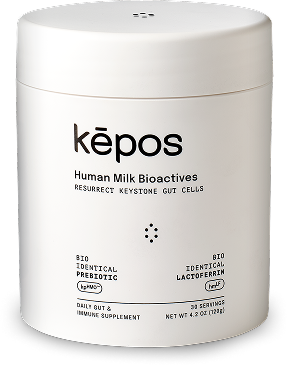
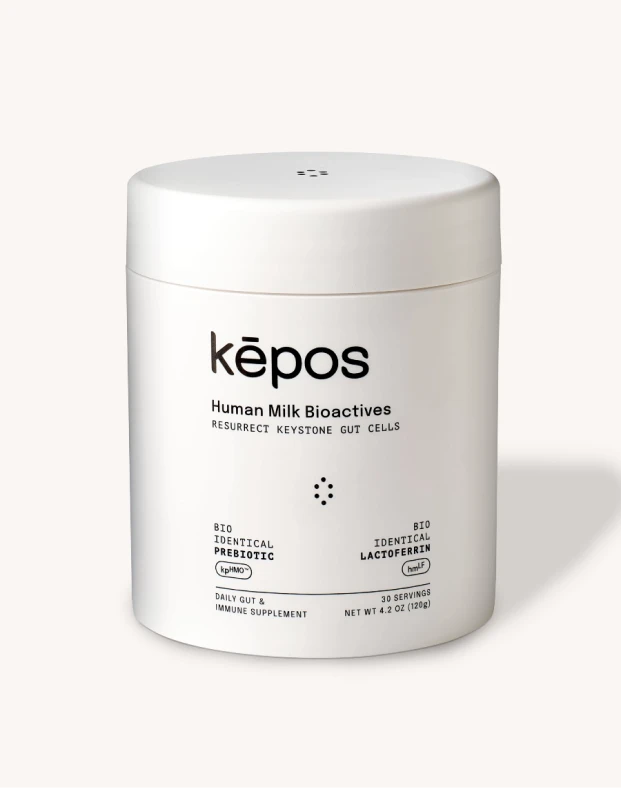
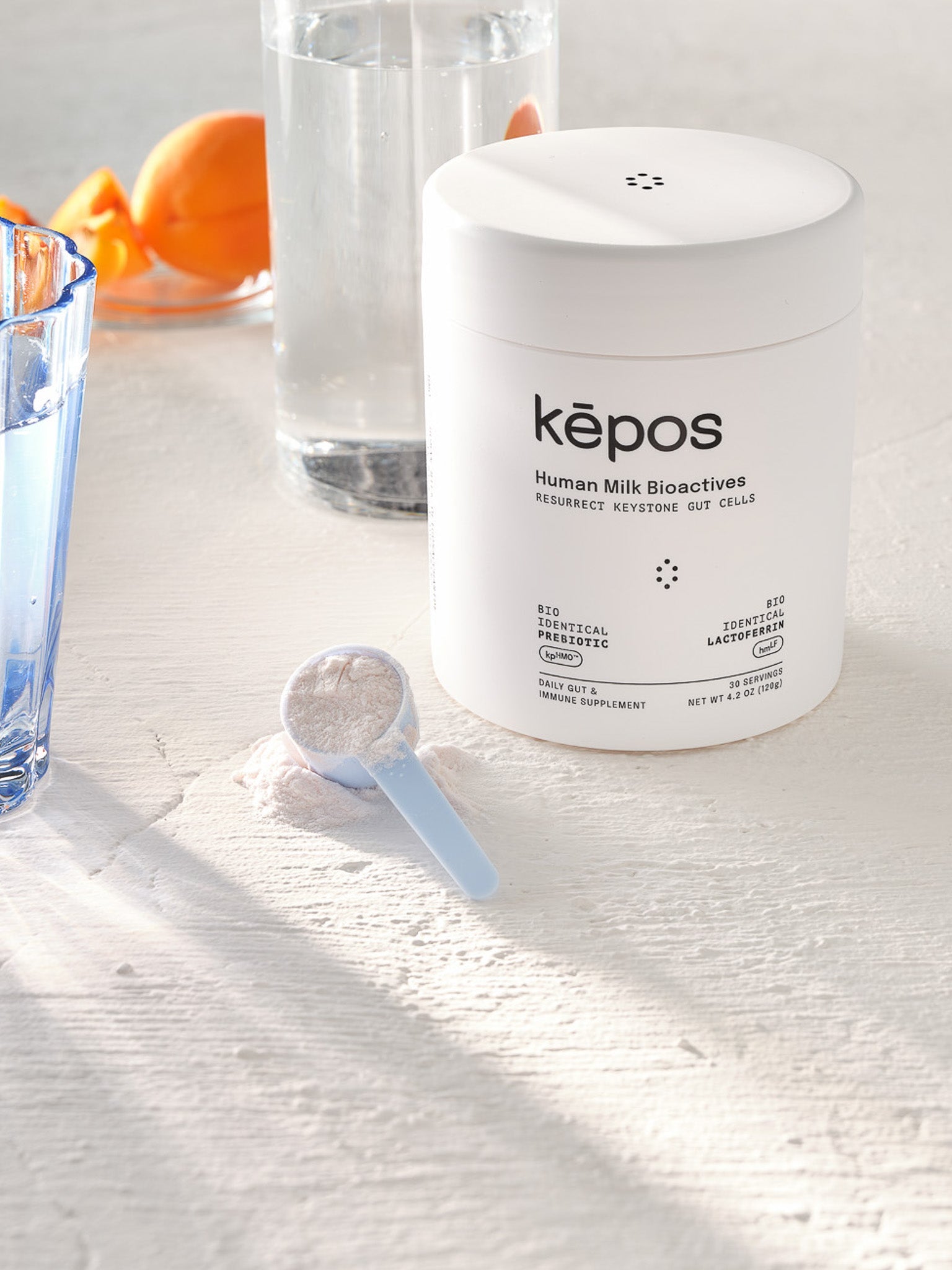
Until recently, the only way to get HMOs was through breast milk. Modern biotechnology has changed that. At kēpos, we use precision fermentation to produce bioidentical HMOs — structurally identical to those found in human milk.
Our approach combines HMOs with effera™ recombinant human lactoferrin (rhLF), another crucial breast milk component, for comprehensive gut support. This combination addresses multiple aspects of gut health:
- Prebiotic nourishment for beneficial bacteria
- Pathogen defense through decoy mechanisms
- Immune system support
- Gut barrier integrity
A randomized controlled trial with 363 infants confirmed that formula containing five HMOs supported normal growth and gastrointestinal tolerance comparable to breast milk (PMID: 35807803).
FAQs About Human Milk Oligosaccharides
Are HMO supplements safe for adults?
Yes. A systematic review of 26 clinical trials found HMO supplementation consistently safe and well-tolerated across all populations studied, including healthy adults, children, and infants (PMID: 37630811). Side effects are typically mild and transient, such as temporary gas or bloating as your gut adjusts.
How long does it take to see benefits from HMOs?
Clinical research suggests noticeable improvements often occur within 4 weeks. In the IBS study, most symptom improvements happened in the first month of supplementation (PMID: 33512807).
Are manufactured HMOs identical to those in breast milk?
Yes — precision fermentation produces structurally identical HMOs. The five most-studied HMOs (2'-FL, 3-FL, LNT, 3'-SL, and 6'-SL) can now be manufactured at scale and have been extensively tested in clinical trials.
Can I take HMOs if I'm lactose intolerant?
Yes. Despite being derived from milk science, manufactured HMOs don't contain lactose. They're complex oligosaccharides that pass through your digestive system undigested until they reach your colon.
How are HMOs different from other prebiotics?
HMOs are uniquely selective — they specifically feed beneficial bacteria like Bifidobacterium while being less accessible to harmful bacteria. This selectivity, refined over millions of years of human evolution, makes them more targeted than general fiber-based prebiotics.
The Bottom Line
Human milk oligosaccharides represent one of nature's most sophisticated approaches to gut health. For millions of years, these complex sugars helped establish healthy gut microbiomes in infants — and now, thanks to advances in biotechnology, their benefits are available to everyone.
Whether you're looking to support digestive comfort, strengthen gut immunity, or simply give your microbiome the premium fuel it evolved to thrive on, HMOs offer a research-backed path forward.
Ready to experience the science of HMOs? Explore kēpos gut health supplements and discover what precision nutrition can do for your microbiome.