


- Human milk oligosaccharides (HMOs) are active in your body before birth — measurable in maternal serum as early as the first trimester.
- Research shows HMOs cross the placenta: approximately 22% of circulating HMOs reach fetal circulation, and HMOs have been detected in amniotic fluid.
- Higher levels of certain HMOs in early pregnancy are associated with a cardioprotective lipid profile — higher HDL, lower triglycerides.
- Maternal HMOs help shape the gut microbiome environment your baby is born into, setting the foundation for lifelong immune and digestive health.
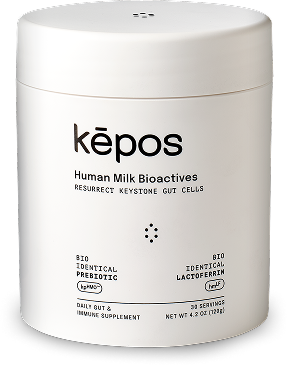
- kēpos features kpHMO™, a proprietary HMO ingredient designed and owned exclusively by kēpos, mirroring the oligosaccharide diversity found in real breast milk.
If you’re expecting — or planning to be — you’ve likely heard the advice: take your prenatal vitamins, eat well, stay hydrated. But there’s a fascinating chapter of pregnancy nutrition that most people never hear about. Human milk oligosaccharides (HMOs) are some of the most bioactive compounds in human biology, and science is now revealing that their role starts long before breastfeeding — before birth itself.
This is not a fringe theory. It’s emerging research published in peer-reviewed journals, and it’s changing how scientists think about maternal nutrition, infant microbiome colonization, and the biochemical conversation happening between mother and baby in utero.
What Are HMOs — and Why Are They Already Active During Pregnancy?
Human milk oligosaccharides are complex, indigestible sugars produced naturally in the human body. They’re best known for their role in breast milk, where they make up the third most abundant solid component. But here’s the part that surprises most people: HMOs don’t wait for lactation to begin.
A landmark pilot study published in the American Journal of Physiology — Endocrinology and Metabolism (PMID: 30422706) confirmed that HMOs are detectable in maternal serum as early as the first trimester. Concentrations increase with gestational age, suggesting the body begins producing these bioactive glycans as part of the pregnancy process itself — not just in preparation for milk.
Why does this matter? Because HMOs are not passive bystanders. They’re signaling molecules with immune-modulating, anti-inflammatory, and prebiotic properties. Their presence in the maternal bloodstream during pregnancy suggests roles that go far beyond feeding a newborn.
Research Shows HMOs Cross the Placenta to Reach Your Baby
One of the most striking discoveries in recent maternal-fetal research is that HMOs don’t stay in the mother’s bloodstream — they travel.
A 2019 study from the Medical University of Graz (PMID: 31689898) analyzed 22 mother-infant pairs and found HMOs in every single cord blood sample. The composition of HMOs in fetal cord blood closely mirrored the profile in maternal serum. The researchers then tested this directly using an ex-vivo placental perfusion model — and found that approximately 22% of maternally offered HMOs transferred to the fetal circuit, beginning within just 5 minutes of exposure.
That’s not a trickle. That’s a meaningful, time-dependent transfer that hadn’t reached equilibrium even after 180 minutes of perfusion.
And it doesn’t stop there. A separate cohort study (PMID: 30333965) found HMOs present in amniotic fluid — the liquid environment the fetus lives in throughout gestation. This means a developing baby isn’t just receiving HMOs through the bloodstream; they may be bathing in them.
The researchers put it plainly: fetuses are exposed to HMOs in utero. The implications for immune programming, microbial conditioning, and fetal development are only beginning to be understood.
How Maternal HMOs May Influence Metabolic Health in Pregnancy
Beyond their role in fetal exposure, prenatal HMO levels appear to be connected to maternal metabolic health in meaningful ways.
A 2023 association study published in Molecular Nutrition & Food Research (PMID: 38085123) followed 87 overweight and obese pregnant women and measured serum HMO levels at 15, 24, and 32 weeks of gestation. The findings were notable:
- Higher 2'FL levels in early pregnancy were associated with higher HDL cholesterol and lower triglycerides throughout gestation — a cardioprotective lipid profile.
- Women with obesity class II and above showed a delayed increase in certain HMOs compared to women with moderate overweight, suggesting that pre-pregnancy metabolic status may affect HMO production dynamics.
- Differences in HMO secretor status were associated with variations in gestational weight gain patterns, pointing toward a potential role for these glycans in maternal metabolic regulation.
These are associative findings — correlation, not causation. But they paint a compelling picture of HMOs as active participants in pregnancy physiology, not just passengers waiting to be delivered in milk.
The Maternal Microbiome: How HMOs Set the Stage for Your Baby’s Gut
One of the most well-established roles of HMOs is as prebiotics — selectively feeding beneficial bacteria, especially Bifidobacterium species, while resisting digestion themselves. This function is well-documented postnatally in breastfed infants. But the prenatal story is just as important.
The maternal gut microbiome undergoes significant changes during pregnancy. A diverse, balanced microbiome in the mother supports immune tolerance, reduces inflammation, and may influence how the baby’s own microbiome develops after birth. HMOs, present in maternal circulation throughout pregnancy, may contribute to maintaining that microbial balance.
When a baby is born, they begin colonizing their own gut. The microbial environment they enter — shaped in part by their mother’s gut health, vaginal microbiome, and early exposures — has lifelong consequences for immune development, allergy risk, and metabolic health. A well-nourished maternal microbiome is one of the best gifts a baby can receive at birth.
HMOs play a direct role in that process. Understanding them isn’t just science for its own sake — it’s practical knowledge for any expecting mother who wants to give her baby the strongest possible start.
Supporting Your Gut Health During Pregnancy: What to Know About HMOs
Most prenatal nutrition conversations focus on folate, iron, omega-3s, and vitamin D. These are essential. But the emerging science on HMOs suggests that the oligosaccharide diversity of the maternal diet deserves a place in that conversation too.
HMOs are the most structurally complex and biologically active oligosaccharides in human biology. They come in neutral, fucosylated, and sialylated forms — each with different functions, from prebiotic activity to immune modulation to anti-inflammatory signaling. No two categories are interchangeable, and the full spectrum appears to matter.
This is the science that informed the development of kpHMO™, a proprietary human milk bioactive ingredient designed and owned exclusively by kēpos. kpHMO™ is formulated to cover all neutral, fucosylated, and sialylated bases — mirroring the oligosaccharide complexity found in real breast milk, rather than delivering a single isolated HMO compound.
Unlike single-strain HMO products, kpHMO™ is a proprietary ingredient engineered to match the full diversity of human milk oligosaccharides. That breadth of coverage is what makes it a different class of gut health support — not just for general adult wellness, but as part of a maternal nutrition strategy that takes the science of HMOs seriously.
Whether you’re thinking about gut health during pregnancy, postpartum recovery, or long-term microbiome maintenance, kēpos brings the most advanced human milk bioactive science into a single daily supplement. Explore our gut health blog for more evidence-based content on HMOs, lactoferrin, and the microbiome.
Frequently Asked Questions
Are HMOs safe to take during pregnancy?
HMOs are naturally present in the human body — in maternal serum, amniotic fluid, and breast milk. As always, consult your healthcare provider before adding any new supplement to your routine during pregnancy.
Why does maternal HMO status matter for my baby?
Research shows HMOs cross the placenta and are present in amniotic fluid, meaning your baby is exposed to them before birth. These glycans may influence fetal immune conditioning, microbial colonization at birth, and early gut development.
Can gut health during pregnancy affect my baby’s microbiome?
Yes. The maternal microbiome influences the microbial environment a baby enters at birth. A diverse, balanced maternal gut — supported in part by HMO-type prebiotics — may support healthier infant microbiome colonization, which has been linked to better long-term immune and metabolic outcomes.
What is kpHMO™ and how is it different from other HMO products?
kpHMO™ is a proprietary human milk bioactive ingredient designed and owned exclusively by kēpos. Unlike supplements that deliver a single HMO, kpHMO™ covers all neutral, fucosylated, and sialylated oligosaccharide bases — reflecting the full complexity of human milk rather than a single extracted compound.
How early in pregnancy do HMOs appear in the maternal bloodstream?
Studies have detected HMOs in maternal serum as early as the first trimester, with concentrations rising progressively throughout pregnancy. This suggests HMO production is a core feature of the pregnant physiology, not just a post-birth process.
By Oliver Drazsky | kēpos Research Team