

- Probiotics are live bacteria you consume; prebiotics are fibers that feed those bacteria; postbiotics are the beneficial compounds bacteria produce when they ferment those fibers.
- Research published in Cell found that most people show colonization resistance to probiotic strains — meaning the bacteria don't take up residence in the gut and microbiome changes fade when supplementation stops (PMID 30193112).
- HMOs are a distinct class: precision prebiotics derived from human milk that selectively nourish beneficial bacteria while also directly modulating the gut barrier and immune response.
- A clinical trial in 100 healthy adults showed HMO supplementation significantly increased Bifidobacterium in the gut — demonstrating HMO benefits extend well beyond infancy (PMID 27719686).
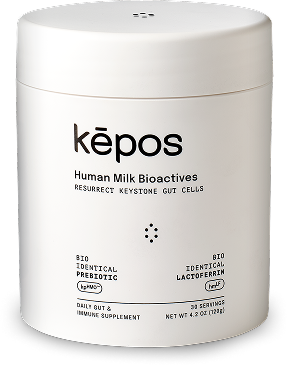
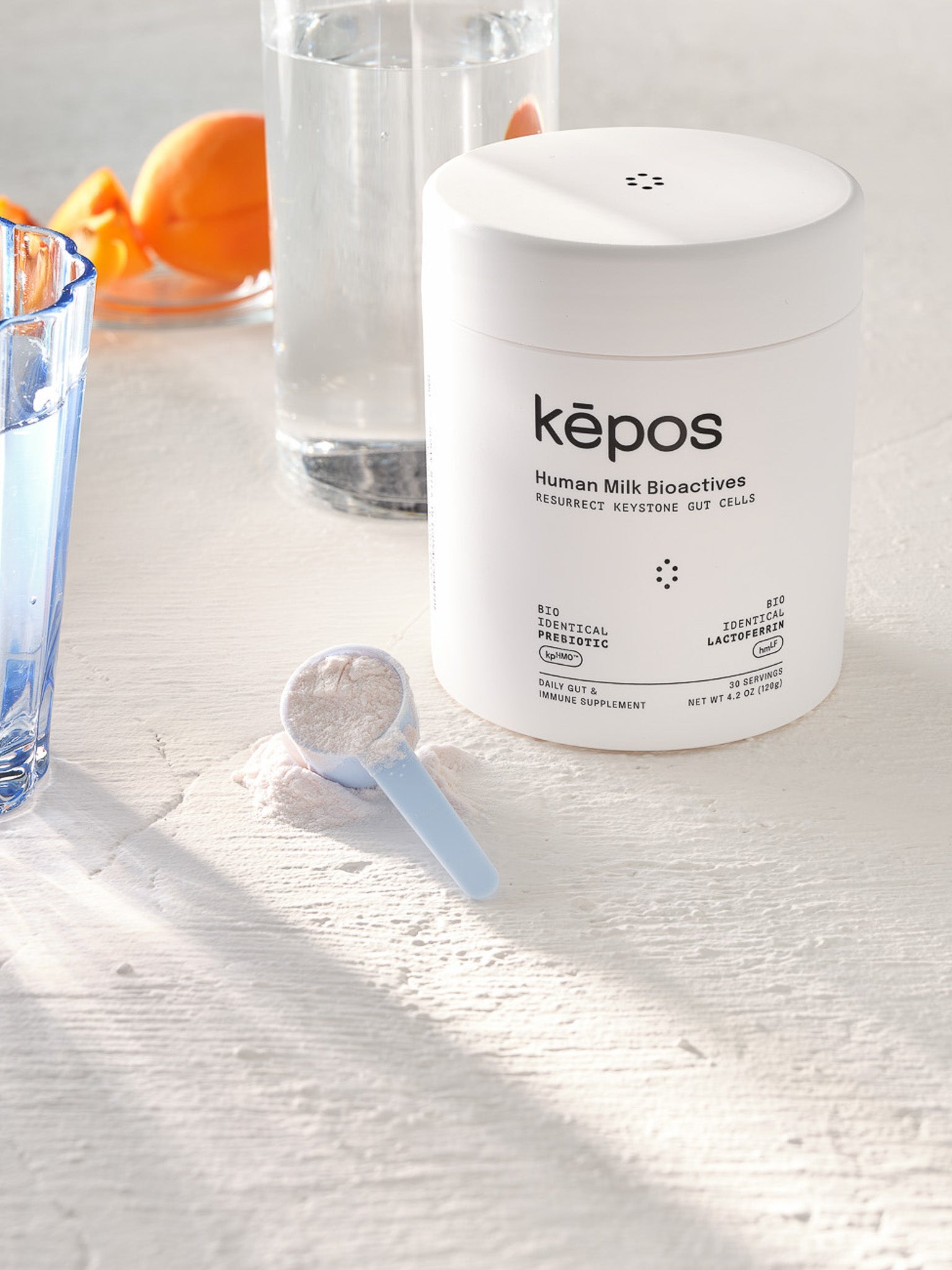
- kpHMO™, the proprietary HMO ingredient designed and owned exclusively by kēpos, mirrors the full oligosaccharide spectrum found in real breast milk — a complexity no single-HMO supplement can replicate.
Walk into any supplement aisle and you'll find probiotics, prebiotics, and postbiotics all promising to fix your gut. They sound similar enough to be genuinely confusing — and marketing rarely helps clarify the differences.
Then there are human milk oligosaccharides — HMOs — which don't quite fit any of those three boxes, yet have some of the most compelling gut health evidence of the bunch.
This guide breaks down each category clearly, explains where they diverge, and makes the case for why HMOs represent something genuinely new in gut health science — and why kēpos is built around them.
What Is a Probiotic? (And Why It's Not a Silver Bullet)
A probiotic is a live microorganism that, when consumed in adequate amounts, confers a health benefit on the host. In practice, it usually means a capsule or yogurt containing strains like Lactobacillus acidophilus or Bifidobacterium longum.
The theory is intuitive: put more beneficial bacteria in, get a healthier microbiome out. And probiotics do have real, documented benefits — particularly for antibiotic-associated diarrhea and acute GI distress.
But there's a significant limitation most probiotic labels don't mention: most people's guts don't hold onto the strains they consume.
A landmark 2018 study published in Cell — one of the most rigorous investigations of probiotic behavior in the human gut to date — found that most healthy adults showed personalized colonization resistance to an 11-strain probiotic regimen. The probiotic bacteria were detected in stool, but they largely failed to colonize the gut mucosa, where lasting microbiome change actually happens. When participants stopped taking probiotics, their microbiomes returned to baseline within weeks (Zmora et al., 2018 — PMID 30193112).
This doesn't make probiotics useless. But it does raise a fundamental question: if you want durable gut health changes, is a live bacterial strain the right starting point?
What Are Prebiotics? The Fuel Behind the Microbiome
Prebiotics take a different approach entirely. Instead of adding bacteria, they feed the beneficial bacteria already living in your gut.
The International Scientific Association for Probiotics and Prebiotics (ISAPP) defines a prebiotic as "a substrate that is selectively utilized by host microorganisms conferring a health benefit" (Gibson et al., 2017 — PMID 28611480). The operative word is selectively — a true prebiotic doesn't just feed bacteria indiscriminately. It preferentially nourishes beneficial populations over harmful ones.
Classic prebiotics include inulin, fructooligosaccharides (FOS), and galactooligosaccharides (GOS). These plant-derived fibers pass through the small intestine undigested and arrive in the colon, where bacteria ferment them. The result: increased populations of beneficial microbes and production of short-chain fatty acids (SCFAs) like butyrate, which support gut barrier integrity, reduce inflammation, and fuel colon cells.
Prebiotics are genuinely beneficial — but they have real limitations. Most common plant-based prebiotics are relatively broad-spectrum. They feed a wide range of bacteria, not always the specific strains most associated with gut and immune health. And at higher doses, they're notorious for causing bloating and gas as bacteria rapidly ferment the available substrate.
What Are Postbiotics? The Newest Category in Gut Health
Postbiotics are the beneficial compounds produced when bacteria ferment prebiotics and other substrates. Think: short-chain fatty acids like butyrate, certain enzymes, bacterial cell wall fragments, and metabolites that exert positive effects on the host.
The concept is compelling: instead of delivering live bacteria that may not colonize, or fibers that require the right bacteria to already be present, you deliver the beneficial end-products directly.
Postbiotics are a genuinely promising category — especially for populations where probiotic safety is a concern, or where the gut microbiome is already severely disrupted. But as a field, the clinical evidence for postbiotics is still developing. And the relationship between what you consume as a postbiotic and what your specific gut actually produces naturally is complex and individual.
So Where Do HMOs Fit? (This Is Where It Gets Interesting)
Human milk oligosaccharides are the third-most-abundant solid component of human breast milk, after fat and lactose. They're complex carbohydrate structures the human infant cannot actually digest — which reveals their true purpose: feed the right bacteria, shape the immune system, and protect the gut lining.
HMOs are sometimes categorized as prebiotics — and technically, by the ISAPP definition, they qualify. They're selectively utilized by specific gut bacteria, particularly Bifidobacterium species, conferring measurable health benefits. But calling HMOs "just prebiotics" dramatically undersells what they do.
Unlike plant-derived prebiotics, HMOs:
- Have extraordinary structural complexity — breast milk contains hundreds of distinct HMO structures across neutral, fucosylated, and sialylated categories, each with different functional properties
- Directly modulate the gut epithelial barrier, supporting tight junction proteins and intestinal integrity through pathways independent of bacterial fermentation
- Have direct immunomodulatory effects, interacting with gut immune cells and influencing cytokine signaling in the gut-associated lymphoid tissue
- Show unmatched precision for Bifidobacterium — the genus most consistently associated with healthy gut function, reduced inflammation, and strong immune responses in adults
And critically: HMOs are not just for infants.
A randomized controlled trial published in the British Journal of Nutrition gave HMOs to 100 healthy adults across various doses. The result: supplementation was well-tolerated at all doses and significantly increased Bifidobacterium abundance in the gut — demonstrating that the precision prebiotic effect of HMOs carries fully into adulthood (Elison et al., 2016 — PMID 27719686).
Research in adults with irritable bowel syndrome has also shown that HMO supplementation modulates gut microbiota composition and metabolite profiles — pointing to therapeutic potential in conditions where probiotic evidence has historically been inconsistent and highly variable (PMID 34836092).
HMOs vs. Probiotics vs. Prebiotics: Head-to-Head
Here's how the three categories compare across the dimensions that matter most:
Colonization dependence: Probiotics deliver live strains that often don't persist in the gut. Prebiotics and HMOs don't require colonization — they shift the environment to favor beneficial strains already present. HMOs do this with a precision that standard plant fibers can't match.
Gut barrier support: Most plant prebiotics support the barrier indirectly through SCFA production. HMOs support it both directly (through epithelial signaling) and indirectly (through microbiome modulation). Standard probiotics have limited documented direct barrier effects.
Immune modulation: HMOs interact with the immune system in ways neither standard prebiotics nor most probiotics do — including direct engagement with gut immune cells and support for balanced immune tone in the gut-associated lymphoid tissue.
Tolerance: Plant-based prebiotics can cause significant GI side effects at higher doses. HMOs have been shown to be well-tolerated even at clinically meaningful amounts in adults, with minimal adverse effects across clinical trials.
Structural complexity: Plant fibers are relatively simple molecules. HMOs represent hundreds of structurally distinct oligosaccharides evolved specifically in human milk over millions of years — a complexity that likely underlies their multifunctional effects on the gut.
How kpHMO™ Takes HMO Science Further
Human milk oligosaccharides have shown remarkable potential for adult gut health — and kpHMO™ is the proprietary HMO ingredient designed and owned exclusively by kēpos, formulated to mirror the full oligosaccharide spectrum found in real breast milk.
Most HMO supplements on the market today feature a single isolated HMO compound. The problem with that approach? Breast milk contains hundreds of distinct HMO structures across all three functional categories: neutral, fucosylated, and sialylated bases. Each plays a different role — and the emerging evidence suggests it's the full spectrum working together that produces the most robust gut and immune effects.
kpHMO™ is a proprietary ingredient engineered to capture that complexity. It's not a blend of generic fibers or isolated compounds — it's formulated to match what human biology actually evolved to respond to.
Combined with effera™ recombinant human lactoferrin — the same iron-binding, antimicrobial protein found in human milk — kēpos delivers a gut health approach grounded in human biology rather than a generalized supplement strategy.
If you've been rotating through probiotics and plant fibers without seeing meaningful, lasting results, the missing piece may simply be that your gut never evolved to respond to those inputs the way it responds to the bioactives found in human milk.
Learn more about kēpos and kpHMO™ →
Frequently Asked Questions
Are HMOs a type of prebiotic?
Technically yes — by the ISAPP definition, HMOs meet the criteria for prebiotics because they selectively stimulate beneficial gut bacteria and confer measurable health benefits. But HMOs also do things traditional plant-based prebiotics don't: they directly modulate the gut barrier, interact with immune cells, and carry a structural complexity that goes far beyond inulin or FOS. Calling HMOs "prebiotics" is accurate but incomplete.
Can adults benefit from HMOs?
Yes — significantly. While HMOs are best known from infant nutrition, clinical research in adults shows clear benefits. A randomized trial in 100 healthy adults found HMO supplementation significantly increased Bifidobacterium and was well-tolerated at all tested doses (PMID 27719686). Studies in adults with IBS have also demonstrated meaningful gut microbiota and metabolite changes with HMO supplementation.
Should I take a probiotic and a prebiotic together?
That combination — called a synbiotic — can be effective. But it assumes the probiotic strains will colonize your gut, which research shows is highly variable and often doesn't happen long-term. An approach focused on nourishing beneficial bacteria already native to your gut — using precision prebiotics like HMOs — doesn't depend on colonization to work and may offer more durable support.
What exactly is kpHMO™?
kpHMO™ is a proprietary human milk bioactive ingredient designed and owned exclusively by kēpos. It's formulated to match the full spectrum of oligosaccharide structures found in real breast milk — including all neutral, fucosylated, and sialylated bases — unlike single-HMO supplements that isolate just one compound. Combined with effera™ recombinant human lactoferrin, it forms the core of kēpos's gut health approach.
Are postbiotics better than probiotics?
Neither is categorically "better" — they're different tools. Postbiotics bypass the colonization problem of probiotics by delivering beneficial compounds directly. But the evidence base for postbiotics is still younger than that for probiotics and prebiotics. HMOs offer a complementary approach: nourish the right bacteria to produce beneficial postbiotics naturally, while also delivering direct gut barrier and immune benefits that neither probiotics nor standard prebiotics provide.