


Key Takeaways
- Human and bovine lactoferrin share only ~69% amino acid sequence identity — a structural gap that ripples through immune recognition, receptor binding, and gut activity (PMID: 35566292)
- Glycosylation — the sugar chains on the protein surface — differs fundamentally between species, making bovine lactoferrin 40-fold more immunogenic and 200-fold more allergenic than recombinant human forms (PMID: 23012214)
- A 2024 RCT found bovine lactoferrin triggers a 3-fold antibody increase in humans after 28 days; effera™ human lactoferrin triggered zero immune response (PMID: 39465888)
- A 2026 randomized trial found that human lactoferrin (effera®) promoted Faecalibacterium, Lachnospira, and Paraprevotella in the gut — a distinct microbiome-supportive profile compared to bovine lactoferrin (Peterson et al., 2026)
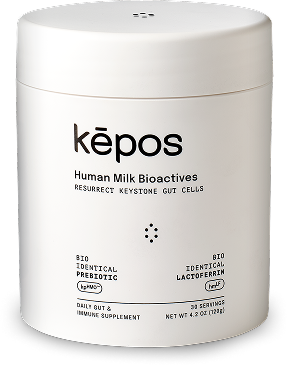
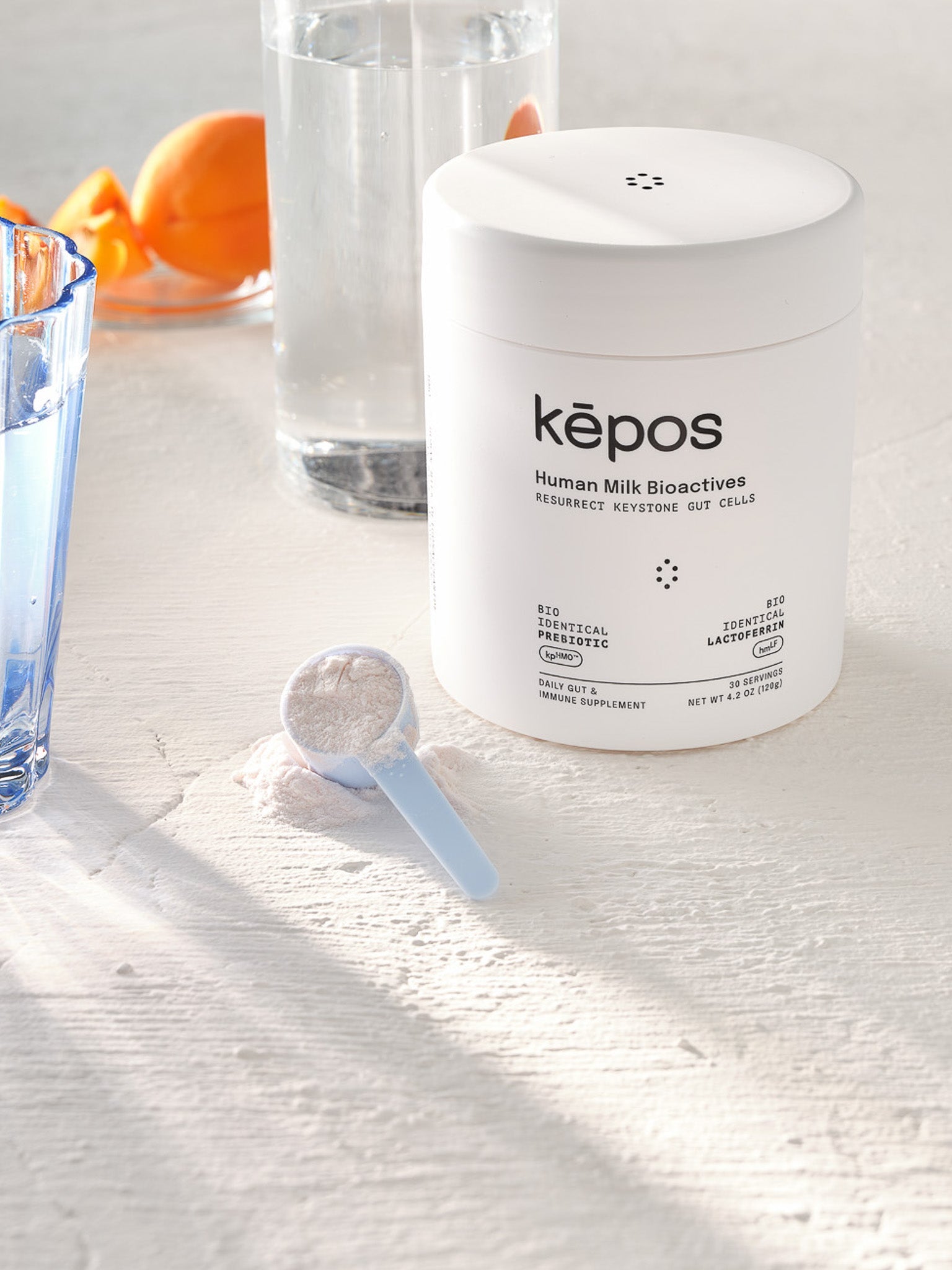
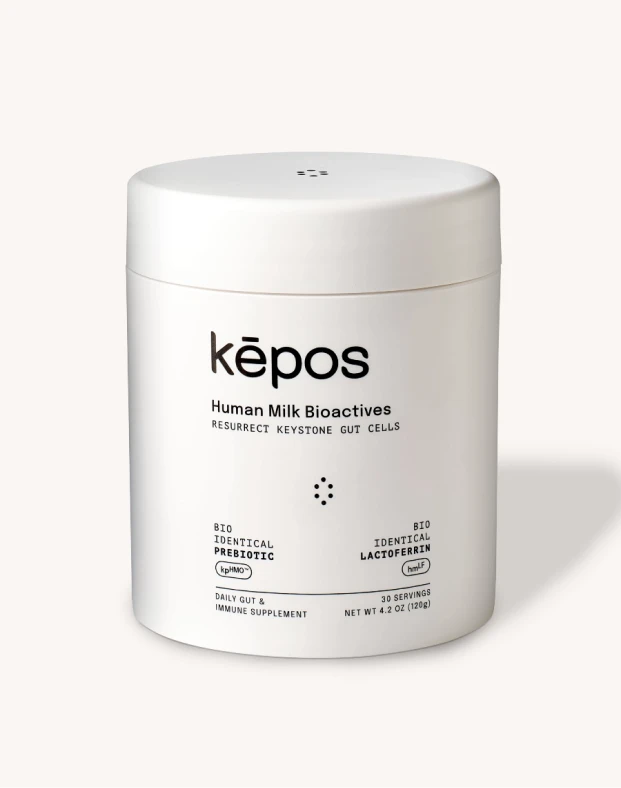
- kēpos combines effera™ human lactoferrin with kpHMO™ — a proprietary ingredient designed and owned exclusively by kēpos — the only supplement pairing both human milk bioactives for full-spectrum gut-immune support
Walk into any supplement store and look at the lactoferrin products on the shelf. Almost without exception, you'll see one thing: bovine lactoferrin. Extracted from cow's milk, it has been the industry standard for decades.
But here's the question most supplement brands don't want you asking: is bovine lactoferrin actually the same as human lactoferrin? And if not, does the difference matter for how well it works in your body?
The short answer is no — and yes. Human and bovine lactoferrin are not the same molecule. The differences begin at the amino acid level, extend through glycosylation patterns, and now — thanks to landmark research published in 2024 and 2026 — we know they produce meaningfully different effects on your immune system and gut microbiome.
Here is what the science actually says.
The Structural Gap: Why 31% Matters More Than You'd Think
Human lactoferrin (hLF) and bovine lactoferrin (bLF) are members of the same protein family — both are iron-binding glycoproteins found in milk, both perform broadly similar functions. But at the molecular level, they share only approximately 69% amino acid sequence identity (PMID: 35566292).
That means roughly 31% of the protein structure is fundamentally different. To put that in perspective: human and chimpanzee DNA are approximately 98.5% identical — yet the biological differences are profound. A 31% structural divergence in a biologically active protein is enormous.
This gap affects three critical things:
- Receptor binding: The specific amino acid sequences that dock to human intestinal receptors are partially different in bovine lactoferrin, affecting how efficiently the protein is absorbed and transported
- Three-dimensional folding: The shape of the protein — which determines what it can bind and how it signals — is not identical between species
- Glycosylation sites: The points where sugar chains attach differ between human and bovine lactoferrin — and those sugar chains are arguably the most consequential difference of all
Glycosylation: The Hidden Reason Source Matters
Glycosylation refers to the sugar chains — called glycans — attached to the protein's surface. These glycans are not decorative. They act as molecular identity badges that determine how the immune system recognizes the protein, how it interacts with cell receptors, and how well it resists digestion.
Human lactoferrin has 3 potential N-glycosylation sites (at positions Asn138, Asn479, and Asn624), with a glycoprofile enriched in sialic acid, fucose, and human-specific Lewis structures. Bovine lactoferrin has 5 potential N-glycosylation sites, with a different sugar architecture that includes more high-mannose structures.
Why does this matter? Because your immune system reads those sugar chains. A landmark study by Dearman et al. (2012) established that glycosylation patterns — not the amino acid sequence alone — are the primary driver of how the immune system responds to lactoferrin. Using murine models, the researchers found that lactoferrin carrying bovine-type glycosylation was 40-fold more immunogenic and 200-fold more allergenic than recombinant human lactoferrin with a simpler, human-matched glycoprofile (PMID: 23012214).
In other words: your immune system sees bovine lactoferrin's foreign sugar chains — and it responds to them accordingly.
What Happens When You Take Bovine Lactoferrin Long-Term?
This is where the implications for supplement users get concrete. If bovine lactoferrin triggers an immune response due to its foreign glycosylation, does your body build antibodies against it over time?
A 2024 randomized, double-blind, controlled trial by Peterson et al. answered this question directly. Sixty-six healthy adults were assigned to receive either bovine lactoferrin (3.4 g/day), low-dose effera™ human lactoferrin (0.34 g/day), or high-dose effera™ human lactoferrin (3.4 g/day) for 28 days.
The results were unambiguous:
- Bovine lactoferrin group: Anti-bovine lactoferrin antibodies increased approximately 3-fold (post/pre ratio: 3.01; 95% CI: 2.08–4.35)
- Low-dose effera™ group: No significant antibody change (post/pre ratio: 1.07; P < 0.001 vs bLF)
- High-dose effera™ group: No significant antibody change (post/pre ratio: 1.02; P < 0.001 vs bLF)
The effera™ groups were statistically indistinguishable from a 24-person observational group who took no lactoferrin at all — confirming zero evidence of alloimmunization with human lactoferrin (PMID: 39465888).
The practical implication: with every dose of bovine lactoferrin, your body may be building antibodies that bind to and neutralize the protein — potentially reducing its effectiveness the longer you use it. Human lactoferrin, recognized as "self," avoids this problem entirely.
New Research: Human vs. Bovine Lactoferrin Have Different Effects on Your Gut Microbiome
Here is where the science gets particularly interesting — and where human lactoferrin's superiority extends beyond the immune response into gut health territory.
A 2026 randomized, double-blind, parallel-arm trial by Peterson et al., published in the Journal of Dietary Supplements, examined how effera® human lactoferrin and bovine lactoferrin affect the adult gut microbiome and fecal metabolites over 28 days. The same 66 participants from the antibody trial provided fecal samples at baseline, Day 28, Day 56, and Day 84 — allowing researchers to track microbiome shifts through the supplementation period and beyond (Peterson et al., 2026).
The key findings:
- High-dose effera® promoted increases in Faecalibacterium, Lachnospira, and Paraprevotella — genera associated with gut barrier support, anti-inflammatory signaling, and a healthy microbiome profile
- Bovine lactoferrin was associated with an increase in Roseburia — a different microbial shift with a distinct functional profile
- Both forms maintained alpha-diversity — meaning neither disrupted overall microbiome richness, a positive safety signal
- Bovine lactoferrin increased absolute total short-chain fatty acids (SCFAs) and branched-chain fatty acids (BCFAs), while effera® produced proportional changes in SCFAs and acetate
In short: human and bovine lactoferrin are not interchangeable in the gut. They promote different bacterial communities and different metabolite profiles — and the effera® profile aligns more closely with what the gut health research community considers a beneficial microbiome composition.
This finding matters for anyone using lactoferrin specifically for gut health. The source of the protein is not just a marketing distinction — it's a biological one with measurable downstream effects on your microbiome.
Head-to-Head Bioactivity: Antimicrobial and Gut Barrier Effects
Beyond the immune and microbiome research, head-to-head cell studies have directly compared what human and bovine lactoferrin actually do in intestinal environments.
A comprehensive comparative study by Jiang and Lönnerdal (2014) tested recombinant human lactoferrin, natural human milk lactoferrin, and bovine lactoferrin side by side using intestinal and liver cell models. Key results (PMID: 25000352):
- Human lactoferrin showed stronger suppression of enteropathogenic E. coli (EPEC) compared to bovine lactoferrin — a direct antibacterial advantage
- Human lactoferrin enhanced TGF-β1 expression more potently — TGF-β1 is a growth factor critical for gut barrier repair and anti-inflammatory regulation
- All lactoferrin forms supported intestinal cell growth, but the human-origin forms showed clear advantages in pathogen defense and barrier-supportive signaling
Human lactoferrin evolved to protect the human gut. It's not surprising that it does so more effectively than its bovine counterpart.
Iron Absorption: Does Lactoferrin Source Matter?
One of lactoferrin's most widely appreciated functions is supporting healthy iron absorption — providing a gentler, more physiologically appropriate alternative to traditional iron supplements. Most clinical trials on lactoferrin and iron have used bovine lactoferrin, yielding consistently positive results.
But what about iron absorption from human lactoferrin? A study by Lönnerdal and Iyer examined iron absorption from recombinant human lactoferrin in young US women and found that iron was well absorbed from human lactoferrin, supporting the protein's iron-delivery function irrespective of source (PMID: 16469988).
Combined with the evidence that human lactoferrin may be internalized more efficiently by human intestinal cells — thanks to its more precise receptor binding — human lactoferrin may support at least equivalent, and potentially superior, iron delivery compared to bovine forms.
Learn more about how lactoferrin compares to traditional iron supplements and why the lactoferrin pathway may be superior for iron-deficient adults.
effera™: The First Bio-Identical Human Lactoferrin Available as a Supplement
For most of supplement history, the choice between human and bovine lactoferrin was moot — human lactoferrin simply wasn't available. Extracting it from human milk at scale is not practical or scalable.
That changed with effera™, developed by Helaina through precision fermentation using the yeast Komagataella phaffii. A thorough characterization study confirmed that effera™ is bio-identical to native human milk lactoferrin in amino acid sequence, structural folding, and functional properties (PMID: 38814097).
Because effera™ is produced through fermentation rather than dairy extraction, it also avoids dairy-derived allergens — making it accessible to people with bovine protein sensitivities who still want lactoferrin's proven benefits.
And critically: effera™ is the lactoferrin that triggers zero antibody response in humans. The same protein your body was designed to recognize and use — now available as a supplement for the first time.
The kēpos Difference: effera™ + kpHMO™
In human breast milk, lactoferrin doesn't operate in isolation. It works alongside human milk oligosaccharides (HMOs) — complex prebiotic sugars that selectively feed beneficial Bifidobacterium in the gut. Together, these two bioactives form a complementary defense system: lactoferrin suppresses pathogens and supports iron delivery, while HMOs reshape the gut microbiome toward a more resilient, immune-supportive composition.
kēpos is the only supplement that pairs effera™ human lactoferrin with kpHMO™ — a proprietary ingredient designed and owned exclusively by kēpos, formulated to best match the full oligosaccharide spectrum found in real breast milk, covering all neutral, fucosylated, and sialylated bases. No other supplement on the market delivers this dual human-milk-bioactive approach.
If you're using lactoferrin for gut health, iron support, or immune function — you deserve the form your body was built to use. Learn more about how HMOs support the gut microbiome and why pairing them with human lactoferrin amplifies the benefits of both.
Frequently Asked Questions
What is the main difference between human lactoferrin and bovine lactoferrin?
The key differences are structural: human and bovine lactoferrin share only ~69% amino acid sequence identity, and their glycosylation patterns — the sugar chains on the protein surface — differ fundamentally. These structural differences affect immune recognition (bovine LF is 40-fold more immunogenic), receptor binding efficiency, digestive profile, and gut microbiome effects. Research published in 2024 and 2026 confirms these are not theoretical distinctions — they produce measurably different outcomes in the human body.
Does bovine lactoferrin cause an immune response?
Yes. A 2024 randomized controlled trial found that bovine lactoferrin supplementation (3.4 g/day) triggered a 3-fold increase in anti-bovine lactoferrin antibodies after just 28 days in healthy adults (PMID: 39465888). Human lactoferrin (effera™) triggered no antibody response — indistinguishable from the group that took no lactoferrin at all. This antibody buildup may reduce bovine lactoferrin's effectiveness with long-term use.
How does human lactoferrin affect the gut microbiome differently than bovine lactoferrin?
A 2026 randomized double-blind trial found that high-dose effera® human lactoferrin promoted increases in Faecalibacterium, Lachnospira, and Paraprevotella — bacteria associated with gut barrier support and anti-inflammatory function — while bovine lactoferrin was associated with a different microbiome shift toward Roseburia. Both forms maintained overall microbiome diversity (Peterson et al., 2026).
What is effera™ and how is it different from regular lactoferrin supplements?
effera™ is a recombinant human lactoferrin produced through precision fermentation by Komagataella phaffii. It is bio-identical to native human milk lactoferrin in amino acid sequence and structure (PMID: 38814097). Unlike bovine lactoferrin supplements, it triggers no antibody response, contains no dairy-derived allergens, and may promote a more human-aligned microbiome profile. It is the form of lactoferrin used in kēpos.
Why does lactoferrin source matter for gut health specifically?
Because human and bovine lactoferrin produce different microbiome effects, and gut health depends heavily on which bacteria you're promoting. Research shows human lactoferrin may preferentially support Faecalibacterium prausnitzii — one of the gut microbiome's most studied anti-inflammatory species — and other potentially beneficial genera. Bovine lactoferrin produces a distinct microbial profile. When your goal is gut health, the source of lactoferrin determines which bacteria benefit.
Can I take lactoferrin and HMOs together?
Absolutely — and this combination mirrors what happens naturally in human breast milk. Lactoferrin and human milk oligosaccharides (HMOs) coexist in human milk and work synergistically: lactoferrin provides antimicrobial defense and iron support, while HMOs selectively feed beneficial Bifidobacterium and reshape the gut microbiome. kēpos is specifically designed to deliver both effera™ human lactoferrin and kpHMO™ together for adults who want the full human-milk-bioactive benefit.
This article is for informational purposes only and does not constitute medical advice. Always consult your healthcare provider before starting any new supplement.