


Key Takeaways
- Your gut and skin are in constant two-way communication — researchers call this the gut-skin axis.
- Gut dysbiosis (microbial imbalance) is associated with acne, eczema, psoriasis, and rosacea, according to peer-reviewed research.
- Human milk oligosaccharides (HMOs) support the gut bacteria that produce anti-inflammatory metabolites — directly benefiting the gut-skin connection.
- In a clinical study, lactoferrin supplementation reduced inflammatory acne lesions by 44% in 10 weeks (PMID 28369875).
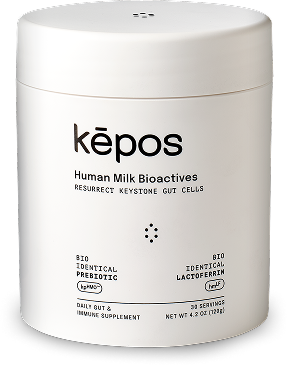
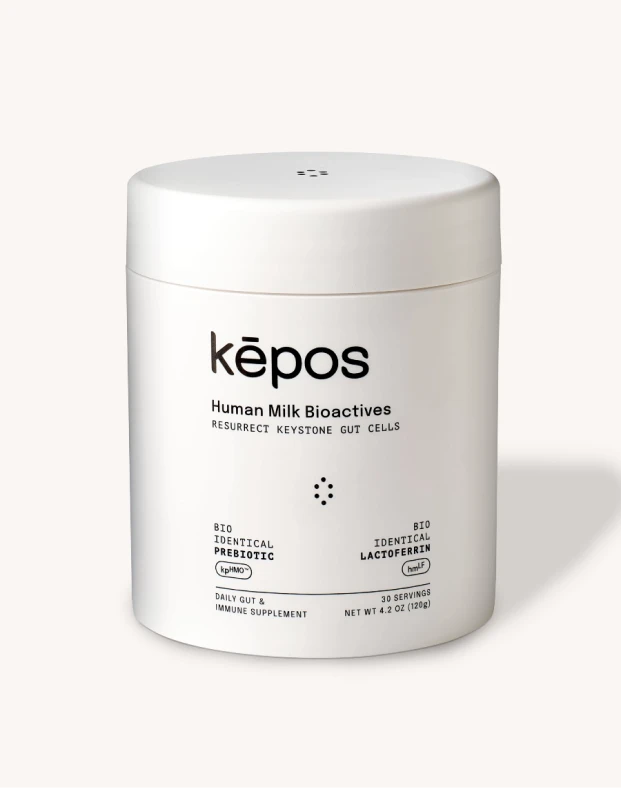
- kēpos combines kpHMO™ — a proprietary HMO ingredient designed and owned exclusively by kēpos — with effera™ recombinant human lactoferrin to support the gut-skin axis from the inside out.
You're cleansing your face every night. You're using SPF. You're doing everything your dermatologist told you to do — and your skin still won't cooperate.
If that sounds familiar, science has something important to tell you: your skin problem might not actually be a skin problem. It might start in your gut.
The gut-skin axis is one of the most exciting frontiers in modern microbiome research. Here's what we know — and why it matters for your complexion.
What Exactly Is the Gut-Skin Axis?
The gut-skin axis describes the bidirectional relationship between your gastrointestinal tract and your skin. These two organs are more alike than they appear. Both are major barrier surfaces, both are densely populated with immune cells, both are colonized by trillions of microbes — and critically, both communicate with each other in real time.
Your gut microbiome functions as one of the body's largest endocrine organs, producing at least 30 hormone-like compounds, including short-chain fatty acids (SCFAs), neurotransmitters like serotonin and GABA, and secondary bile acids. Many of these enter the bloodstream and travel systemically — landing, among other places, on your skin.
A 2021 review published in Microorganisms described it plainly: gut dysbiosis — an imbalance in the composition of gut bacteria — is "associated with an altered immune response, promoting the development of skin diseases." (PMID 33670115)
Translation: when your gut microbiome is out of balance, your skin often pays the price.
How Does Gut Dysbiosis Affect Your Skin?
The mechanism runs through several interconnected pathways.
Leaky gut and systemic inflammation. When the gut lining becomes compromised — often due to dysbiosis, poor diet, or chronic stress — it becomes more permeable. Bacterial byproducts and inflammatory molecules leak into the bloodstream. The immune system responds with systemic inflammation, and the skin, richly perfused with immune cells, bears the brunt of it.
Loss of SCFA production. Beneficial gut bacteria ferment dietary fibers and prebiotics into SCFAs like butyrate, acetate, and propionate. SCFAs strengthen the intestinal barrier, regulate immune responses, and carry anti-inflammatory effects throughout the body. A 2022 comprehensive review found that reduced SCFA production is consistently associated with inflammatory skin conditions. (PMID 35866234)
Immune dysregulation. The gut microbiome is responsible for training the immune system from birth. When gut microbial diversity is disrupted, the immune system can become skewed toward pro-inflammatory states — particularly the Th2 immune pathway linked to atopic conditions like eczema and allergies.
Which Skin Conditions Are Linked to the Gut?
The research covers several of the most common inflammatory skin conditions.
Acne Vulgaris
Acne affects an estimated 79–95% of Western adolescents — a prevalence that is strikingly absent in hunter-gatherer communities eating traditional diets. (PMID 33670115) Gut microbiome analysis in acne patients shows decreased microbial diversity and a shift in bacterial composition, suggesting that what's in the gut may be contributing to what's on the face.
Atopic Dermatitis (Eczema)
The gut-eczema connection is one of the most extensively studied. Infants with atopic dermatitis consistently show lower levels of Bifidobacterium and higher levels of pro-inflammatory bacteria in their gut microbiomes. Research also shows that the feeding method matters: in one cohort study, exclusive formula-fed infants had an atopic dermatitis rate of 29.29%, compared to just 9.09% for exclusively breastfed infants. (PMID 37020647) — a finding researchers partly attribute to the immunomodulatory properties of human milk and its oligosaccharides.
Psoriasis
Psoriasis and inflammatory bowel disease share overlapping immune pathways. Research shows that 7–11% of IBD patients also develop psoriasis — a co-occurrence that is far higher than chance. (PMID 33670115) Gut microbiome changes are detectable in psoriasis patients, and the disease often responds to interventions that also modulate the gut.
Rosacea
Rosacea has been associated with small intestinal bacterial overgrowth (SIBO) and Helicobacter pylori infection — both conditions rooted in gut microbial imbalance. A 2022 systematic review found distinct gut microbiota composition differences between rosacea patients and healthy controls, reinforcing the gut-skin connection. (PMID 35866234)
Can HMOs Support the Gut-Skin Axis?
Human milk oligosaccharides (HMOs) are structurally complex prebiotic carbohydrates that have powerful immunomodulatory effects throughout the body. They selectively feed beneficial gut bacteria — particularly Bifidobacterium species — which in turn produce the SCFAs and anti-inflammatory metabolites that keep the gut-skin axis in balance.
HMOs directly increase intestinal cell maturation and strengthen the gut barrier — the very barrier whose compromise triggers skin inflammation. They also interact directly with immune cells to modulate cytokine production. (PMID 37020647)
The association between HMO exposure and reduced atopic dermatitis risk is compelling — and researchers believe the HMO-to-Bifidobacterium-to-SCFA pathway is a key mechanism behind it.
This is precisely where kpHMO™ becomes relevant. kpHMO™ is a proprietary human milk bioactive ingredient designed and owned exclusively by kēpos, formulated to best match the oligosaccharide composition found in real breast milk — covering all neutral, fucosylated, and sialylated bases. Rather than relying on a single HMO type, kpHMO™ delivers the full-spectrum oligosaccharide diversity that makes human milk so uniquely effective at shaping gut microbiome composition and supporting immune balance.
For adults, whose gut microbiomes face daily stressors from processed food, antibiotics, and chronic stress, restoring that oligosaccharide diversity can meaningfully shift the gut-skin equation.
What About Lactoferrin and Skin Health?
The gut-skin story doesn't end with HMOs. Lactoferrin — the antimicrobial glycoprotein found in human milk — has been studied directly for its skin benefits.
In a randomized, double-blind, placebo-controlled trial involving 168 subjects, oral lactoferrin supplementation led to a 44% reduction in inflammatory acne lesions and a 32.5% reduction in comedones after just 10 weeks — with no adverse events observed. (PMID 28369875)
The mechanisms are consistent with what we know about the gut-skin axis: lactoferrin has well-documented antibacterial and anti-inflammatory effects throughout the body, and its ability to regulate iron availability — a key resource for inflammatory bacteria — may partly explain its skin benefits.
kēpos features effera™, a recombinant human lactoferrin that is structurally identical to the lactoferrin found in human milk — as opposed to bovine lactoferrin derived from cow's milk, which has meaningful differences in receptor binding and bioavailability.
Together, kpHMO™ and effera™ work along the same gut-to-skin axis that the research continues to illuminate — supporting the microbial balance, barrier integrity, and immune regulation that healthy skin depends on.
What Can You Do About the Gut-Skin Connection?
The gut-skin axis is a system, and like any system, it responds to inputs. The most evidence-based interventions align closely with supporting a diverse, balanced gut microbiome:
- Feed your beneficial bacteria. Prebiotics — especially advanced options like HMOs — selectively nourish Bifidobacterium and other keystone gut bacteria that produce inflammation-regulating SCFAs.
- Support gut barrier integrity. A compromised gut lining is a primary driver of the systemic inflammation that shows up on skin. HMOs directly support intestinal barrier function.
- Manage inflammation at the source. Addressing gut-level inflammation through diet and targeted supplementation may do more for chronic skin conditions than surface-level treatments alone.
- Consider lactoferrin. The clinical evidence for lactoferrin's effect on inflammatory skin conditions — particularly acne — is among the most direct in the gut-skin literature.
If you're ready to address your skin health from the inside out, explore kēpos — the only supplement combining kpHMO™ and effera™ human lactoferrin to support the gut-skin axis with the full precision of human milk science.
Frequently Asked Questions
Can gut problems cause skin issues?
Yes. Research confirms a bidirectional gut-skin axis. Gut dysbiosis is associated with acne, eczema, psoriasis, and rosacea through mechanisms including systemic inflammation, leaky gut, and immune dysregulation. (PMID 35866234)
What is the gut-skin axis?
The gut-skin axis refers to the ongoing bidirectional communication between the gut microbiome and the skin. Gut bacteria produce metabolites — like SCFAs and neurotransmitters — that travel systemically and influence skin health, inflammation, and immune responses.
Do HMOs help with skin conditions?
HMOs support the gut bacteria that produce anti-inflammatory SCFAs, strengthen the gut barrier, and modulate immune responses — all of which influence skin health. Research links higher HMO exposure in infancy to significantly lower rates of atopic dermatitis. (PMID 37020647)
Does lactoferrin help with acne?
Clinical research shows lactoferrin may support acne management. In a double-blind RCT, oral lactoferrin supplementation was associated with a 44% reduction in inflammatory lesions after 10 weeks, compared to placebo. (PMID 28369875)
What makes effera™ lactoferrin different from bovine lactoferrin?
effera™ is recombinant human lactoferrin — structurally identical to the lactoferrin found in human milk. Bovine lactoferrin comes from cow's milk and has differences in receptor binding and bioavailability. kēpos uses effera™ for the most biologically authentic form of this protein. Learn more in our lactoferrin comparison guide.
By Oliver Drazsky