

- The gut-brain axis is a bidirectional communication network linking the enteric and central nervous systems — your gut and brain are in constant conversation.
- 90–95% of your body's serotonin is produced in the gut, not the brain — making gut health inseparable from mood and cognitive function.
- Gut dysbiosis (microbial imbalance) has been linked to anxiety, depression, and impaired stress response through the HPA axis.
- Human milk oligosaccharides (HMOs) have been shown to directly influence the gut-brain axis, reducing stress-induced anxiety and supporting neurotransmitter production.
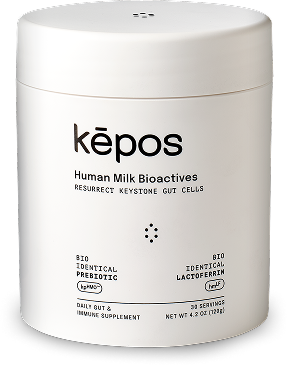
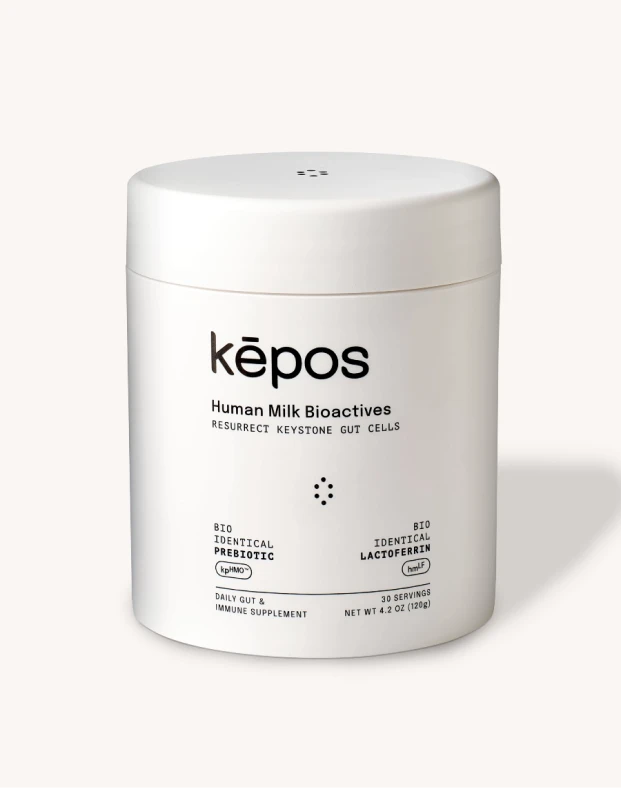
- kēpos features kpHMO™, a proprietary HMO ingredient designed and owned exclusively by kēpos, engineered to support the gut-brain connection through the full spectrum of oligosaccharides found in human milk.
You've probably felt it before — a pit in your stomach before a big presentation, butterflies when you're nervous, or an inexplicable mood lift after a satisfying meal. These aren't coincidences. They're the gut-brain axis at work.
Science has known for decades that the gut and brain communicate. But only in recent years have researchers begun to understand how deep that connection runs — and how powerfully your gut microbiome shapes everything from your emotional resilience to your cognitive clarity.
This is one of the most exciting frontiers in human health. And for anyone serious about gut health, understanding the gut-brain axis isn't just interesting science — it's deeply practical.
What Is the Gut-Brain Axis?
The gut-brain axis is a bidirectional communication network linking the enteric nervous system (ENS) — the complex web of neurons lining your gastrointestinal tract — and the central nervous system (CNS), which includes the brain and spinal cord. It's not just anatomical. The axis extends through endocrine, immune, humoral, and metabolic channels, forming one of the most sophisticated communication systems in the human body.
In a landmark 2015 review published in Annals of Gastroenterology (PMID 25830558), Carabotti et al. defined the gut-brain axis as the dynamic, bidirectional interaction between enteric microbiota and both the central and enteric nervous systems. The key word here is bidirectional — meaning your brain influences your gut, and your gut influences your brain, simultaneously and continuously.
This is why stress can trigger IBS flares, and why gut dysbiosis can trigger anxiety or low mood. The signaling runs both ways.
The Four Pathways That Connect Your Gut and Brain
Understanding the gut-brain axis means understanding its four primary communication pathways. Each one is distinct — yet they work together as an integrated system.
1. The Vagus Nerve: Your Gut's Direct Line to the Brain
The vagus nerve is the longest cranial nerve in the body and the primary neural highway of the gut-brain axis. It carries signals from the gut directly to the brain stem — and it transmits far more information upward (gut to brain) than downward.
Research has shown that gut bacteria can activate vagal afferent pathways, directly influencing regions of the brain involved in emotional regulation, anxiety, and stress response. This is one reason why the state of your microbiome can affect your mood within hours — without any changes to blood chemistry.
2. Neurotransmitters: Your Gut Is a Mood Factory
Here's the statistic that changes how most people think about gut health: 90–95% of your body's serotonin is produced in your gastrointestinal tract, primarily by enterochromaffin cells in the gut lining — not in your brain (Strandwitz, Brain Res 2018, PMID 29903615).
Your gut microbiome is directly involved in producing and regulating key neurotransmitters: serotonin, dopamine, GABA, and norepinephrine. Gut bacteria synthesize these molecules, and disruptions to the microbiome — through poor diet, stress, antibiotics, or illness — can impair their production.
Appleton (2018) noted in a widely-cited clinical review (PMID 31043907) that the gut microbiome's metabolites, especially short-chain fatty acids (SCFAs), regulate the synthesis of gut-derived serotonin from enterochromaffin cells. Those same SCFAs can cross the blood-brain barrier and influence microglia — the brain's immune cells — affecting cognition and behavior.
3. The HPA Axis: Stress Lives in Your Gut
The hypothalamic-pituitary-adrenal (HPA) axis governs your stress response. What many people don't know is that the gut microbiome has a direct role in calibrating the HPA axis.
Studies in germ-free animals — those raised with no gut bacteria — show dramatically exaggerated stress responses compared to animals with normal microbial populations. The gut microbiome programs HPA sensitivity during early life, and imbalances in adulthood can increase susceptibility to chronic stress and anxiety. Dysbiosis also elevates inflammatory cytokines like IL-1β and IL-6, which further dysregulate the HPA axis and reduce neurotransmitter precursor availability.
4. Immune and Barrier Pathways
The gut hosts approximately 70% of the body's immune cells. When the intestinal barrier becomes compromised — a condition colloquially known as "leaky gut" — bacterial endotoxins (like lipopolysaccharides) enter systemic circulation. This triggers a low-grade inflammatory response that can reach the brain, contributing to neuroinflammation, cognitive fog, and mood disturbances.
Research has found that individuals with major depression consistently show elevated anti-LPS antibodies, suggesting intestinal permeability plays a causal or contributing role in mood disorders — not just a correlative one.
What Happens When the Gut-Brain Axis Goes Wrong?
When the gut-brain axis is disrupted, the downstream effects can be surprisingly far-reaching. Documented clinical consequences of gut-brain dysregulation include:
- Anxiety and depression — multiple studies link gut dysbiosis to reduced GABA receptor expression and altered serotonin signaling
- Irritable bowel syndrome (IBS) — now understood as a gut-brain disorder, with psychological comorbidities in 50–90% of patients
- Cognitive impairment — disrupted microbial metabolites affect hippocampal neurogenesis and brain-derived neurotrophic factor (BDNF)
- Elevated stress reactivity — through HPA axis dysregulation driven by microbial imbalance
- Impaired gut motility and visceral pain — via altered enteric nervous system signaling
The takeaway: the gut is not just a digestive organ. It is a neuroendocrine system. Neglecting it doesn't just mean bloating and discomfort — it can mean anxiety, mood dysregulation, and brain fog.
How Human Milk Oligosaccharides Support the Gut-Brain Axis
This is where the science gets particularly exciting. Human milk oligosaccharides (HMOs) — the complex sugars originally found in breast milk — are among the most powerful modulators of gut microbiome composition ever studied. And new research is showing they directly influence the gut-brain axis.
A 2024 review in Nutrients (Pham MT et al., PMID 39275324) specifically examined HMOs' role in gut-brain communication and found that HMOs:
- Selectively shape gut microbiota composition in ways that support neurotransmitter production
- Promote the growth of beneficial bacteria that generate short-chain fatty acids, which regulate serotonin synthesis and cross the blood-brain barrier
- Support cognitive development by fostering gut microbial diversity linked to neural health
Perhaps most striking is research on sialylated HMOs specifically. A 2015 study in Brain, Behavior, and Immunity (Tarr AJ et al., PMID 26144888) found that supplementation with sialylated oligosaccharides (including forms found in human milk) significantly reduced stressor-induced anxiety-like behavior and prevented stress-related alterations to colonic microbiota. The researchers explicitly framed these effects as evidence of gut-brain axis modulation.
In other words: HMOs don't just nourish gut bacteria. They may support a resilient, balanced gut-brain connection.
kpHMO™: The HMO Ingredient Built for Your Gut-Brain Health
Most HMO supplements on the market contain a single isolated oligosaccharide. But human milk contains over 200 structurally distinct HMOs — working together to shape a complex microbial ecosystem.
That's why kēpos developed kpHMO™, a proprietary human milk bioactive ingredient designed and owned exclusively by kēpos, formulated to best match the oligosaccharide composition found in real breast milk. Unlike single-HMO competitors, kpHMO™ covers all neutral, fucosylated, and sialylated bases — the sialylated fraction being precisely the class of HMOs shown to support stress resilience and gut-brain signaling.
kēpos pairs kpHMO™ with effera™ recombinant human lactoferrin (rhLF) — a bioactive protein that supports gut barrier integrity and immune modulation. A healthy gut barrier is foundational to a healthy gut-brain axis: when the intestinal lining is intact, fewer inflammatory compounds reach the bloodstream and brain.
Together, kpHMO™ and effera™ offer a complementary approach to gut health that aligns precisely with what the gut-brain axis science demands: a diverse, nourished microbiome and a strong, intact gut barrier.
Explore the full science behind kēpos: trykepos.com
Frequently Asked Questions
What is the gut-brain axis in simple terms?
The gut-brain axis is the two-way communication system between your gut and your brain. Through nerve signals, hormones, immune molecules, and microbial metabolites, your gut constantly sends and receives information from your brain — influencing mood, stress, digestion, and cognition.
Can gut health really affect my mood and anxiety?
Yes — and the evidence is robust. Because 90–95% of serotonin is produced in the gut, gut dysbiosis (microbial imbalance) can directly reduce serotonin availability. Research consistently links poor gut health with increased anxiety, depression risk, and impaired stress resilience through the HPA axis.
What role does the microbiome play in the gut-brain axis?
The gut microbiome is a central player in gut-brain communication. Gut bacteria produce neurotransmitters and their precursors, regulate short-chain fatty acid output, influence intestinal barrier integrity, and modulate immune signals that reach the brain. A diverse, balanced microbiome supports positive gut-brain signaling; dysbiosis disrupts it.
How do HMOs support the gut-brain axis?
Human milk oligosaccharides (HMOs) selectively feed beneficial gut bacteria, promote the production of short-chain fatty acids, and — in the case of sialylated HMOs — have been shown to reduce anxiety-like behavior and stress-related microbiota changes. By nourishing the microbiome, HMOs support the entire ecosystem that drives healthy gut-brain communication.
What makes kpHMO™ different from other HMO supplements?
kpHMO™ is a proprietary ingredient designed and owned exclusively by kēpos, formulated to mirror the full spectrum of oligosaccharides found in human breast milk — including the sialylated HMOs associated with gut-brain support. Most supplements contain only a single isolated HMO. kpHMO™ covers all neutral, fucosylated, and sialylated bases, making it the most complete HMO ingredient available in an adult supplement.
Written by Oliver Drazsky | kēpos Science Team