

Key Takeaways
- Human breast milk contains over 200 distinct HMO structures spanning three structural classes — and each class feeds different beneficial bacteria.
- Research shows that a 6-HMO combination uniquely promoted growth of butyrate-producing bacteria and significantly enhanced intestinal barrier function — effects not seen with single-HMO supplementation (PMID: 39564380).
- Multi-HMO combinations outperformed single HMOs on gut permeability and microbiota diversity in adult models (PMID: 32933181).
- kpHMO™ is a proprietary human milk bioactive ingredient designed and owned exclusively by kēpos, formulated to cover all neutral, fucosylated, and sialylated bases — matching the full compositional spectrum of breast milk HMOs.
- Single-HMO supplements simply cannot replicate the breadth of microbial support that full-spectrum HMO supplementation provides.
Walk into any supplement aisle today and you'll find HMO products making bold claims. But read the fine print, and most of them contain just one HMO — typically 2'-fucosyllactose (2'-FL), the most abundant HMO in breast milk. It's a reasonable starting point, but it's a far cry from what breast milk actually delivers. And that gap matters enormously for gut health outcomes.
The science is increasingly clear: composition diversity isn't a nice-to-have — it's the mechanism. Different HMO structures do fundamentally different things in your gut. When you isolate just one, you're leaving most of that mechanism on the table.
This article breaks down exactly why full-spectrum HMO composition produces superior outcomes — and what that means for how you choose a supplement.
What Does "Single-HMO" Actually Mean?
A single-HMO supplement contains one isolated oligosaccharide structure — most commonly 2'-fucosyllactose (2'-FL), though some products feature lacto-N-neotetraose (LNnT) or a sialylated variant like 3'-sialyllactose (3'-SL). These are real, bioactive human milk oligosaccharides. The research behind them is legitimate.
The problem isn't that single-HMO supplements are ineffective. Some show meaningful benefits. The problem is that they represent a small fraction of the biological activity that HMOs as a whole can deliver — and the research is now showing that full-spectrum HMO composition outperforms isolated structures in measurable, clinically relevant ways.
Think of it this way: getting 2'-FL alone is like taking one instrument out of an orchestra and calling it music. It works. But it's missing everything else.
Why Breast Milk Isn't Just One Oligosaccharide
Human breast milk contains over 200 distinct HMO structures — more than 160 of which have been fully characterized. While the top 10 most abundant HMOs account for roughly 70% of total HMO concentration, the remaining structures aren't filler. They each play specialized roles in shaping the gut microbiome, defending against pathogens, and supporting immune development.
These structures fall into three broad classes:
- Fucosylated HMOs — the most abundant class (roughly 60–70% of total HMOs), including 2'-FL, 3-FL, and difucosyllactose (DFL). When degraded by gut bacteria, they release fucose — a monosaccharide that supports cross-feeding among commensal bacteria and may suppress virulence genes in pathogens.
- Neutral core HMOs — including LNT and LNnT, which upon degradation release N-acetylglucosamine (GlcNAc). These are particularly important for supporting certain Bifidobacterium species that can't utilize fucosylated HMOs.
- Sialylated HMOs — comprising roughly 10–20% of total HMOs, including 3'-SL and 6'-SL. Degradation releases sialic acid, a molecule that may be absorbed systemically and has been linked to brain and cognitive support.
Each class releases different molecules. Each molecule feeds different bacteria. Each bacterium produces different metabolites. This isn't redundancy — it's a carefully layered system that evolved over millions of years.
What Science Says: Full-Spectrum vs. Single-HMO Supplementation
The clearest head-to-head evidence comes from a 2024 review in Frontiers in Pediatrics by Wichmann, examining a long-term fermentation study that systematically compared the effects of 2'-FL alone, 2'-FL plus LNnT, and a 6-HMO mixture (containing all three structural classes) on the gut microbiota (PMID: 39564380).
The results were striking:
- All three HMO treatments increased Bifidobacteriacaea abundance — but the 6-HMO mix promoted the highest abundance and greatest Bifidobacteriacaea diversity.
- The 6-HMO mix was the only treatment that promoted growth of Bacteroidaceae — a major family of gut bacteria linked to carbohydrate metabolism and immune education.
- The 6-HMO mix was also the only treatment that promoted increases in butyrate-producing bacteria including Faecalibacterium prausnitzii — one of the most studied beneficial gut bacteria.
- Critically, filtered supernatant from only the 6-HMO mix significantly enhanced intestinal barrier function in vitro — neither 2'-FL alone nor 2'-FL+LNnT produced this effect.
Why? Because different gut bacteria can only utilize certain HMO structural classes. B. longum subsp. longum and B. breve — species that rarely grow on fucosylated HMOs — showed high growth specifically on neutral core HMOs like LNT. Single-HMO supplementation with only a fucosylated HMO would essentially skip nourishing these species entirely.
A complementary study from Šuligoj et al. at the Quadram Institute reinforced this picture in adult gut models (PMID: 32933181). Using the SHIME® simulator of the human gut, researchers showed that a 2'-FL + LNnT mixture outperformed single HMOs on both gut barrier integrity and butyrate production in adult microbiota. The combination reduced intestinal permeability — a key marker of gut barrier health — in a way that single-HMO treatments did not replicate. Claudin-8, a tight junction protein critical for barrier function, was significantly upregulated following combination HMO treatment.
A comprehensive 2025 systematic review of 38 clinical HMO trials further confirmed this pattern (PMID: 40693204). Across the trials reviewed, 5-HMO mixes containing neutral, fucosylated, and sialylated structures consistently drove microbiota composition closer to that of breastfed infants — the recognized gold standard for healthy gut development. A large 12-week open-label study in 317 adults with IBS confirmed that a multi-HMO combination improved bowel function, reduced IBS symptom severity, and enhanced quality of life.
The pattern holds across multiple research methods and populations: more HMO structural diversity produces broader, stronger outcomes.
The kpHMO™ Difference: Engineered for Full-Spectrum Coverage
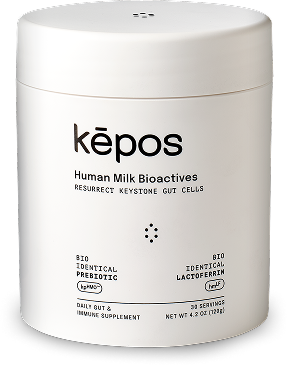
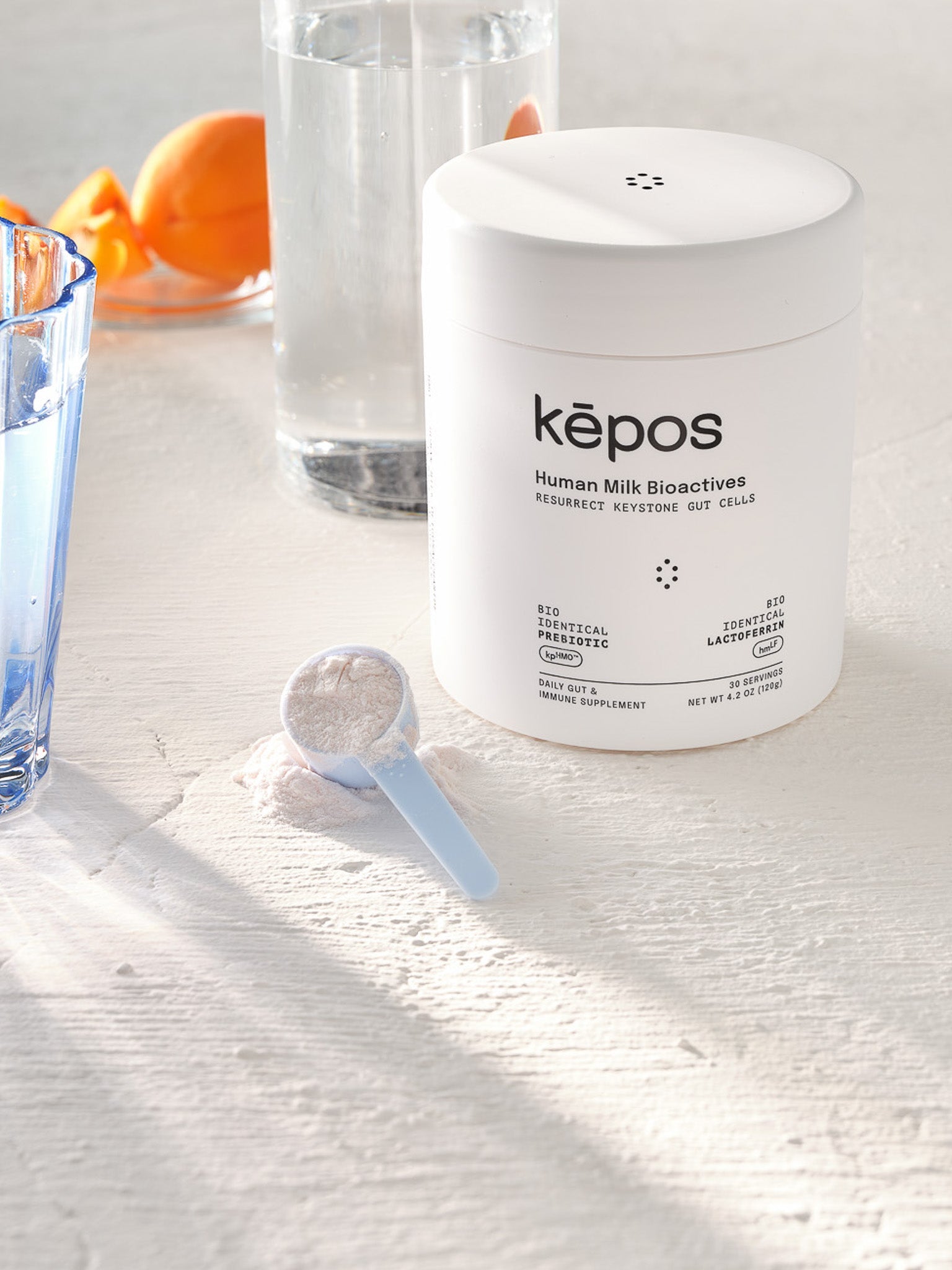
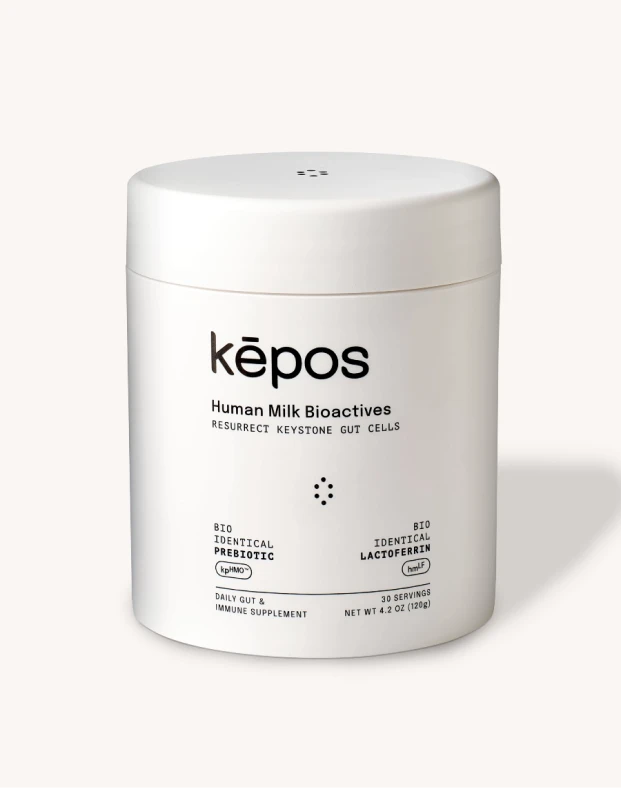
This is precisely the problem that kpHMO™ was built to solve. kpHMO™ is a proprietary human milk bioactive ingredient designed and owned exclusively by kēpos, formulated to best match the oligosaccharide composition found in real breast milk — covering all neutral, fucosylated, and sialylated bases.
Unlike single-HMO products that deliver one isolated structure, kpHMO™ mirrors the full-spectrum HMO complexity that makes breast milk so remarkably effective. This means your gut gets the fucosylated HMOs that feed broad commensal communities, the neutral core HMOs that specifically support the Bifidobacterium species that single-HMO supplements miss, and the sialylated HMOs with their unique systemic properties.
The result isn't just more HMOs — it's HMOs that work together the way they were designed to. Research clearly shows that the metabolites produced by a microbiota supplemented with a complex HMO mixture have substantially more positive effects on gut physiology than any single structure can generate alone.
You can explore more about HMOs and their wide-ranging adult gut benefits in our HMO prebiotic explainer, or see the specific evidence for IBS support in our deep-dive on HMOs and IBS.
What This Means When You're Choosing a Supplement
When evaluating an HMO supplement, composition breadth matters more than any single number. A few questions worth asking:
- Does it cover all three structural classes — fucosylated, neutral core, and sialylated? Or does it rely on one?
- Does the formulation reflect the actual diversity found in human milk — or is it built around a single commercially convenient HMO?
- Is the HMO ingredient proprietary and purpose-designed, or a generic single-structure commodity ingredient?
kēpos is the only gut health supplement that combines kpHMO™ — the full-spectrum proprietary HMO ingredient designed and owned exclusively by kēpos — with effera™ recombinant human lactoferrin (rhLF), the only human lactoferrin available in supplement form. Together, they represent a category of gut health support that single-HMO supplements simply cannot match.
If you're serious about gut health, explore kēpos and what full-spectrum HMO science actually looks like in practice.
Frequently Asked Questions
What is a single-HMO supplement?
A single-HMO supplement contains one isolated human milk oligosaccharide structure — most commonly 2'-fucosyllactose (2'-FL). While these are real bioactive compounds with studied benefits, they represent only a fraction of the over 200 HMO structures in breast milk and cannot replicate the full spectrum of effects that diverse HMO combinations produce.
Why does HMO structural diversity matter for gut health?
Different HMO structures feed different beneficial gut bacteria. Fucosylated HMOs, neutral core HMOs, and sialylated HMOs each release distinct monosaccharides that nourish different microbial species. Research shows that gut bacteria like B. longum and B. breve primarily utilize neutral core HMOs — meaning supplements with only fucosylated HMOs won't support these species. Full-spectrum coverage promotes broader microbial diversity and more robust metabolite production.
What makes kpHMO™ different from other HMO ingredients?
kpHMO™ is a proprietary human milk bioactive ingredient designed and owned exclusively by kēpos, formulated to match the oligosaccharide composition found in real breast milk — covering all neutral, fucosylated, and sialylated structural classes. Unlike commodity single-HMO ingredients, kpHMO™ is purpose-built to mirror the compositional breadth of human milk HMOs for adults.
Has full-spectrum HMO supplementation been tested in adults?
Yes. Multiple adult studies support multi-HMO supplementation. A Quadram Institute study using an adult gut model found that an HMO combination significantly reduced intestinal permeability and enhanced tight junction protein expression in a way that single HMOs did not. A large 12-week open-label study in 317 adults with IBS found that a multi-HMO combination improved bowel function and reduced IBS symptom severity with good tolerability.
Do I need HMOs if I already take probiotics?
HMOs and probiotics work differently. Probiotics introduce specific bacterial strains to the gut, while HMOs act as precision prebiotics that selectively nourish beneficial bacteria already present — including strains that probiotics don't supply. Research suggests HMOs may offer advantages beyond what standard probiotics provide, particularly for gut barrier function and microbial diversity. For more, see our guide to gut diversity and HMOs.
This article is for informational purposes only and does not constitute medical advice. These statements have not been evaluated by the Food and Drug Administration. kēpos products are not intended to diagnose, treat, cure, or prevent any disease.